

Selina Kuss, BA MA
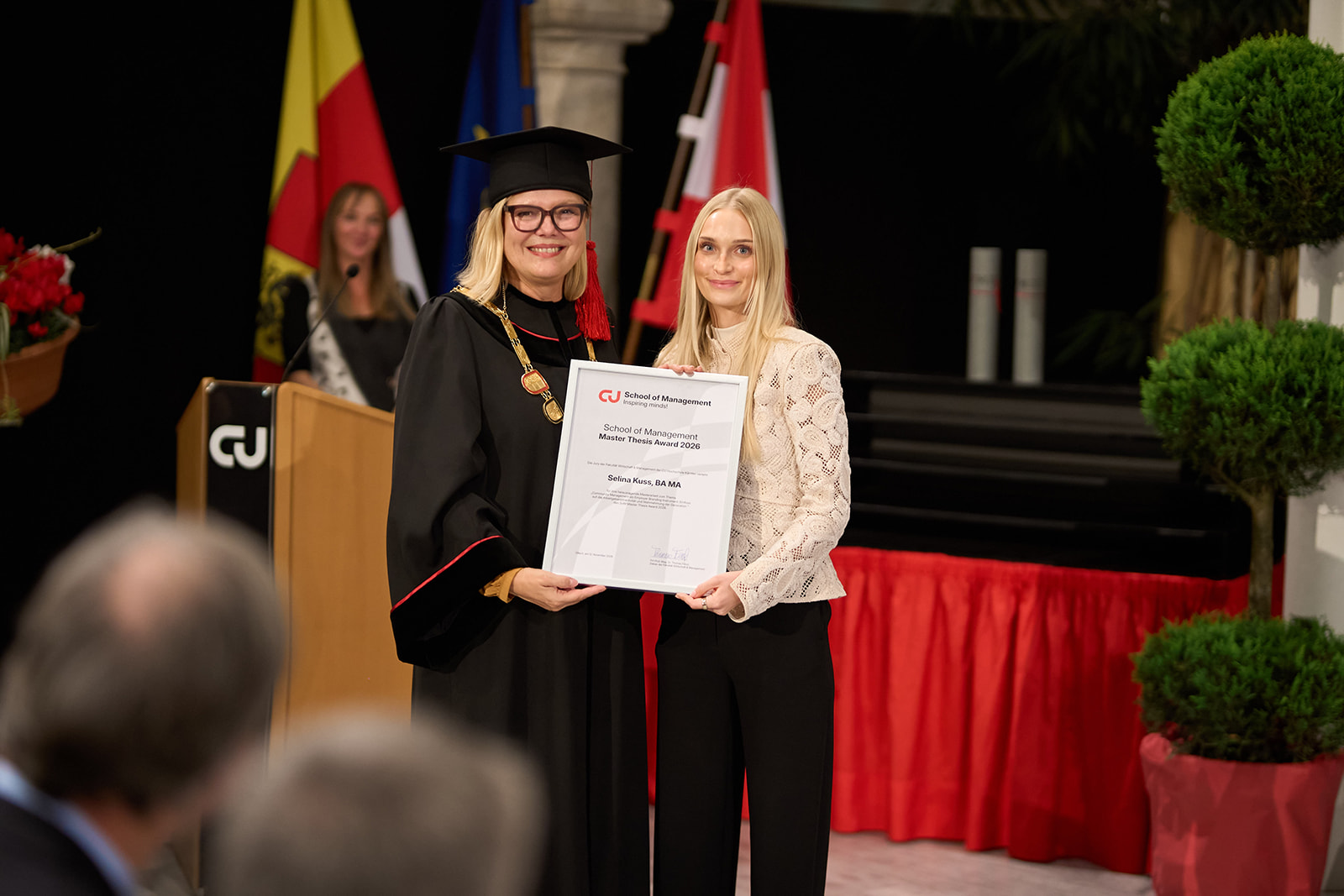
Graduate Business Development & Management
Thesis title:
Community Management as an Employer Branding Tool: Its Impact on Employer Attractiveness and Perception Among Generation Z.
Statement by the Graduate
“Communities and the need for interaction and a sense of belonging have long since ceased to be concerns limited to our private lives; they now extend into our professional lives as well. What is particularly interesting is how companies can embrace and leverage this trend to remain relevant and attractive as employers. My academic exploration of this topic has shown me the potential inherent in the concept of community and the new perspectives it offers for shaping employer-employee relationships. I am all the more delighted that my work has been recognized with the SOM Master’s Thesis Award, which also helps bring greater attention to the importance of this field of research.”
Topic of the Master’s Thesis
This Master’s thesis examines the influence of community management on companies’ employer attractiveness among Generation Z. The starting point for this study is the growing importance of strategic employer branding in the context of a skilled labor shortage, demographic change, and shifting expectations among young target groups regarding potential employers. While existing research approaches to employer branding predominantly view it from a communication- and image-oriented perspective, this thesis analyzes community management as a relational and community-oriented approach to the sustainable development of employer attractiveness. At the heart of the study is the research question of what influence community management has on the employer attractiveness of companies among Generation Z.
A qualitative-empirical research approach was chosen to answer the research question. The empirical study is based on the analysis of two corporate communities specifically targeting young audiences. A total of 14 guided interviews were conducted, including six interviews with community members, six interviews with representatives of the primary case study, and two interviews with representatives of a comparison company. Data analysis was performed using qualitative content analysis according to Mayring and combined theory-driven and empirically data-based category formation.
Key Findings
The findings show that community management significantly shapes Generation Z’s perception of employer attractiveness. Communities are not primarily perceived as traditional communication or recruiting tools, but rather as social spaces within which employer brands are actively experienced, interpreted, and evaluated on an emotional level. In particular, factors such as authenticity, transparency, social belonging, personal interaction, trust, and emotional connection proved to be key influencing factors. Furthermore, the study illustrates that community management primarily exerts its influence through long-term relationship-building and experiential processes, thereby enabling traditional employer branding approaches to be expanded to include relational and community-oriented dimensions.
Practical Relevance
This study makes both a theoretical and empirical contribution to linking the research fields of employer branding, community management, and Generation Z research, and highlights the strategic potential of community-based approaches for future employer brand management.
Communities and the need for interaction and a sense of belonging have long since ceased to be concerns limited to our private lives; they are now also a significant part of our professional lives. Of particular interest is how companies can address and leverage this trend to remain relevant and attractive as employers. My academic exploration of this topic has shown me the potential inherent in the concept of community and the new perspectives it offers for shaping employer-employee relationships. I am therefore all the more delighted that my thesis has been honored with the SOM Master’s Thesis Award, which also brings greater attention to the importance of this field of research.