

Digital Transformation & AI Management - MA
Program Overview
In the Digital Transformation & AI Management master’s program, you’ll combine management, data, and technology with the application of artificial intelligence. You’ll learn to develop digital business models and transformation strategies, evaluate AI applications from a business perspective, and responsibly shape digital change processes. You’ll also explore data analysis, automation, and AI governance.
- Qualification awarded: Master of Arts in Business (MA)
- Duration: 4 semesters
- Mode of study: Work-friendly
- Location: Campus Villach
- ECTS: 120
- Language of Instruction: German
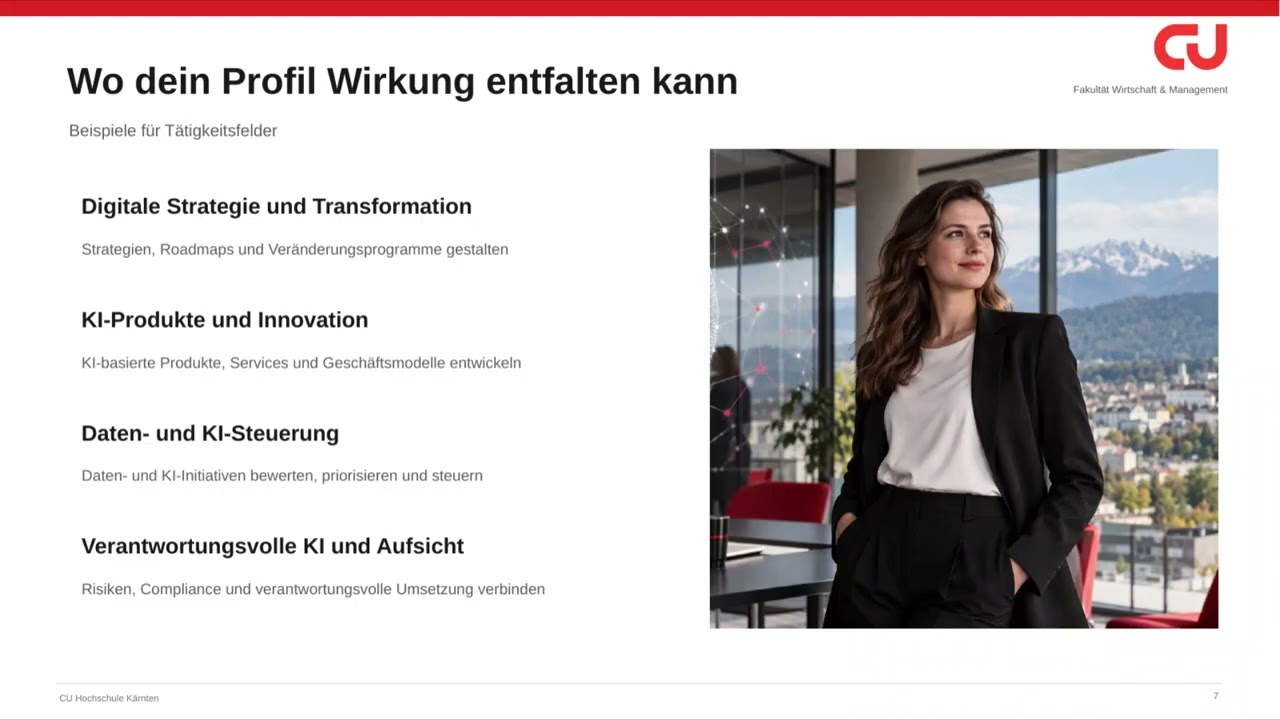
The Digital Transformation & AI Management master’s degree program equips you to shape digital transformation in businesses and government agencies in a strategic, technological, and data-driven manner. You’ll combine management, technology, and data analytics into a skill set that is in high demand in the digital economy.
During the program, you’ll further develop digital business models, use data as the basis for informed decisions, and learn to effectively assess and apply innovative technologies such as artificial intelligence, business intelligence, and platform solutions. As such, the program is particularly geared toward graduates with a background in business, digital fields, or IT-related disciplines who wish to work at the intersection of business and technology.
The continuous work on real-world problems is particularly hands-on: Through several case studies, you’ll support companies in their digital transformation processes and develop solutions from strategy through implementation. The work-friendly study schedule, featuring predictable on-campus weekends and online instruction, helps you effectively balance your studies, career, and personal life.
What exactly will you learn?
- Development, analysis, and implementation of digital business models and platform strategies
- Application of data analytics, machine learning, and business intelligence to support decision-making
- Designing transformation, marketing, and technology strategies within organizations
- Modeling and optimizing digital processes, as well as implementing modern IT and cloud technologies
- Examining the legal, ethical, and societal aspects of digitalization
- Building leadership and change management skills for digital organizations
* Subject to accreditation by AQ Austria.
Why is this degree program more than just a traditional IT or business degree?
You will learn to evaluate technological options from a business perspective and align them with strategic, organizational, and operational goals.
What role does artificial intelligence play in college?
You will explore the potential applications of AI and learn to assess its technological potential in economic and organizational contexts.
How do you learn to use data effectively?
You work with statistics and the R programming language, analyze data, and use that analysis to make informed decisions.
Are you ready to shape the digital future in a sustainable way?
Then let’s set the course for progress.
Special features of the program
A study program that is compatible with a career and allows for planning
Studying while remaining active in the workforce: This program is designed to help students effectively balance their studies, career, and personal life. The combination of scheduled in-person sessions and online instruction creates a structured learning environment while also allowing for flexibility in scheduling. This enables students to immediately apply, test, and reflect on new insights gained from their studies in relation to challenges in their own professional context.
Practical Relevance and Application-Oriented Learning
The focus is not only on what digital technologies and artificial intelligence can do, but above all on how they can be used to develop concrete solutions for businesses and organizations. Case studies, project-based assignments, and real-world problems combine academic and methodological foundations with practical application. This approach brings together expertise in strategy, AI, data, technology, and management. Students learn to structure digital problems, evaluate suitable technologies, develop solution concepts, and present results in a clear and understandable manner.
Integrating Business, Data, AI, and Technology
Digital transformation cannot be achieved through technology alone. That is why this program combines business and strategic thinking with data literacy, artificial intelligence, an understanding of technology, and leadership and change management skills. Students examine digital and AI-driven initiatives from multiple perspectives: Does the technology align with the strategy? Is appropriate data available? What benefits does its application provide? How can it be embedded within the organization? What changes will this bring about for processes and people? This integrated approach distinguishes this program from a purely technical or purely business-focused education.
Understanding, Evaluating, and Managing Artificial Intelligence
Artificial intelligence is not viewed in isolation as a single technological topic. It serves as a common thread that spans from the fundamentals and generative AI, through operational use cases and automation, to AI product management, data and technology issues, and AI governance. The focus is deliberately on the management perspective: Students learn to identify AI’s potential, classify and evaluate use cases, and understand the strategic, organizational, technological, and economic prerequisites for successful implementation.
Responsible Digital Transformation and AI Governance
Those who shape digital transformation and artificial intelligence take on responsibility. That is why technological and economic issues are linked to governance, ethics, data protection, transparency, and risk management. Students develop an understanding that successful AI applications must not only function technically, but also be transparent, manageable from an organizational perspective, and designed responsibly. Governance is not viewed as a downstream control mechanism, but rather as an integral part of professional AI management.
From Technological Potential to Measurable Impact
New technologies are relevant to companies and organizations when they generate tangible benefits. That is why the program focuses on the connection between innovation and value realization. Students explore how digital and AI-driven initiatives can be evaluated, prioritized, and translated into viable projects. This includes business cases, costs, benefits, and risks, as well as metric-based performance measurement and the organizational prerequisites for implementation. The central question is how a technological opportunity can be transformed into a responsible and measurable improvement.
Details about the program




Info Box
Level of qualification
Master
ECTS credits
120
Tuition fees*
€ 363.36 / Semester
ÖH (Austrian Student Union) fee
€ 26.20 / Semester
Qualification awarded
Master of Arts in Business
Duration of study
4 Semester
Language of instruction
German
CU Campus
Villach
Dates Info Box
Winterterm 2027
Period 1: 01.11.-15.03.
Period 2: 16.03.-31.05.
Period 3: 01.06.-31.07.
Period 4: 01.08.-30.09.*
Please note the country-specific regulations!
*We reserve the right to close this period early.
The semester starts in October - we only offer intake in winterterm!
The start of lectures can be found in the individual timetable which is available after enrollment.
Online:
Tuesday & Thursday
starting at 5.40 p.m.
Friday starting at 1.30 p.m.
Saturday starting at 8:30 a.m.
On site:
5-6 weekends (Friday and Saturday) per semester
An overview on our upcoming events can be found here.
You are interested in a personal (online) study consultation or would like to receive more information on the degree program? Click on the buttons below this checkbox to learn more.
Language of Instruction: German (min B2)
Application essentials:
More information on the application process, admission requirements and necessary documents can be found here.
* Tuition for non-EU/EEA citizens: €500 + €26.20 ÖH fee (per semester)
FAQ
Frequently asked questions about the
“Digital Transformation & AI Management” Master’s Degree Program
What makes this degree program special?
You’ll combine strategy, data, AI, organization, and implementation. In this way, you’ll learn to assess the economic potential of technology, shape it responsibly, and translate it into concrete transformation projects.
What role does AI play in the program?
Artificial intelligence is covered as a management and implementation topic. You’ll explore the fundamentals, generative AI, machine learning, business use cases, automation, AI product management, and responsible AI governance. The focus is on how AI can be used in a strategically sound, economically viable, and responsible manner.
How can data be used effectively?
You will develop data literacy to support informed management decisions. This includes data quality, statistics, visualization, business intelligence, and exploratory and predictive analytics.
Insights into the Program
Students, graduates, and faculty members share firsthand accounts of the Master’s degree program in Digital Transformation & AI Management, everyday student life, and their experiences at CU Carinthia University of Applied Sciences.
Book an online information session
During the online information sessions, the program directors or academic directors provide detailed information about the program. Topics include course content, internships, and potential career prospects.

FH-Prof. DI Martin Stromberger
Program Director
+43 5 90500 2433
m.stromberger(at)cuas.at
INFORMATION & APPLICATION
Virtual Campus Tour
Contact

Mag. Michaela Rosenwirth
Administration
+43 5 90500 2403
m.rosenwirth(at)cuas.at
On foot
From the Villach Seebach train station, you can reach the campus in about 20 minutes on foot (1.6 km). The route follows the Drau River to the campus.
By public transportation
The campus is directly accessible from Villach Central Station via bus lines 3 and 8 to the “Technologiepark” stop. From the Villach Seebach train station, you can also reach the campus by taking bus line 8 to the “Technologiepark” stop. The Villach city bus schedules are coordinated with the ÖBB schedules.
By car
Coming from Klagenfurt/Vienna, take the A2 Südautobahn to the Wernberg exit. From there, follow the B83 Kärntner Straße toward Villach for about 2 km, then follow the signs toward Magdalenen See or Technologiepark.
Coming from Salzburg/Munich via the A10 Tauern Autobahn, take the Villach/Ossiacher See exit and follow the B33 Kärntner Straße for about 2 km toward Wernberg/Klagenfurt. Then turn toward Magdalenen See and follow the road to the Technology Park.
There are several free parking spaces right in front of the building, and additional paid parking spaces are available in the surrounding area.
By Plane
There are several airports in the area:
- Klagenfurt: approx. 30-minute drive
- Ljubljana (Slovenia): approx. 1-hour drive
- Graz: approx. 2-hour drive
- Salzburg: approx. 2-hour drive
- Trieste and Venice (Italy): about 2 to 3 hours by car
- Vienna: about a 4-hour drive
- Munich: approx. 4-hour drive
From there, you can continue your journey to the Villach campus by train, bus, taxi, or car.