

Featured Project of the Month: RADAR Care
Using Radar Technology and Smart Textiles to Shape Modern Care for Older People
Europe’s population is ageing – and with it comes a growing need for new approaches to care and support. The two-year Interreg project RADAR Care addresses this challenge by further developing technological solutions that support older people in their everyday lives while respecting their privacy.
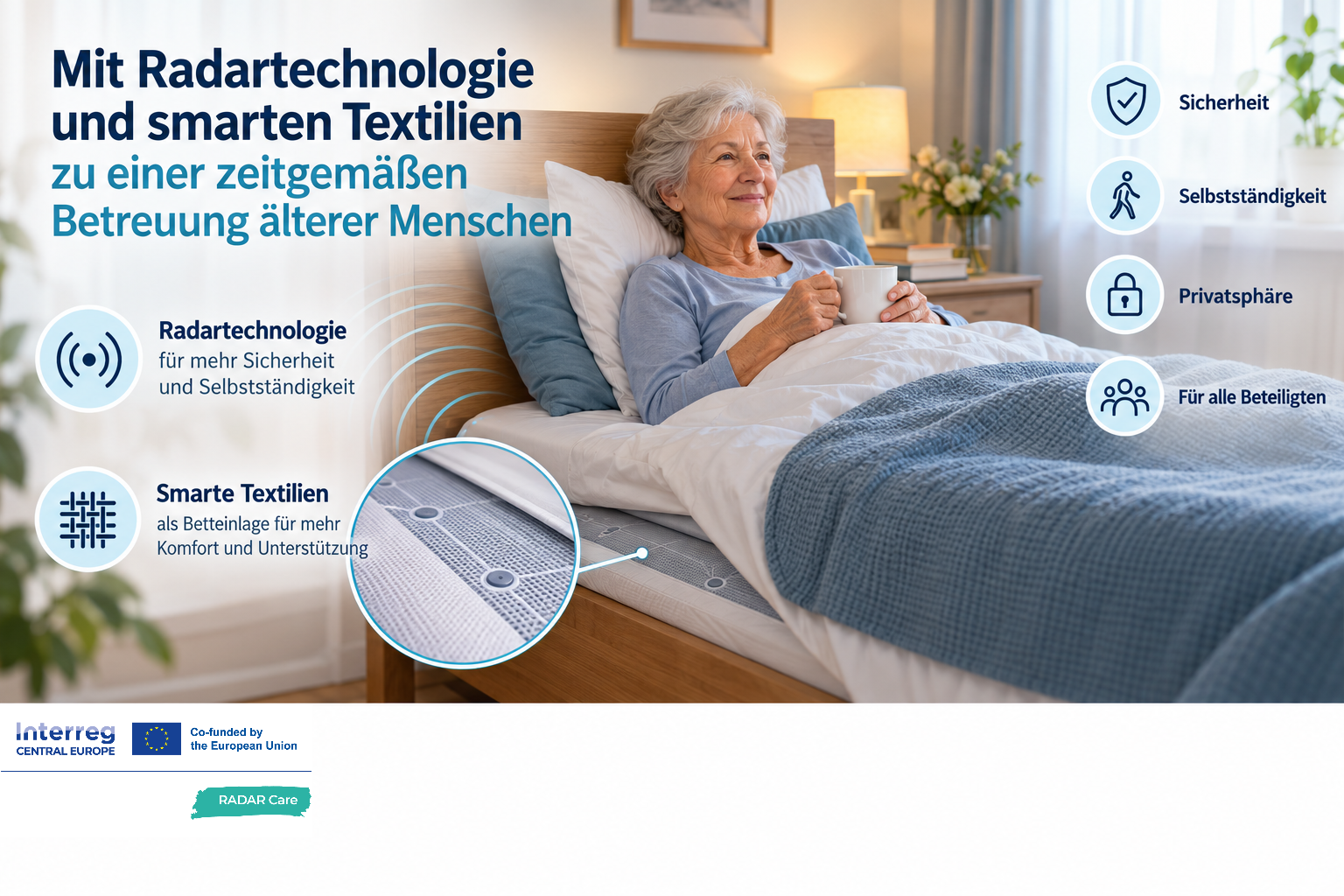
At the heart of the project is the combination of radar technology and smart textiles. The technology is designed to provide information about everyday situations without relying on conventional camera systems. This approach explores how the safety and independence of older people can be supported without unnecessarily intruding on their privacy.
RADAR Care builds on the experience and results of previously completed cross-border and transnational Interreg projects. These solutions will be adapted to new regions and different care settings and tested together with project partners and associated partners in a range of care and support environments.
A particular challenge lies in the cross-border nature of the collaboration. Different legal frameworks, healthcare and care structures, and varying levels of digitalisation influence how new technologies can be used in care settings. RADAR Care takes these differences into account and establishes a common framework for sharing experiences across the participating regions and further developing practical solutions for responsible and human-centred use.
In addition to older people, the project also targets family members and informal carers, professional care and support staff, healthcare organisations, and public institutions. In this way, RADAR Care connects technological development with a pressing societal challenge: how can care and support be designed in the future to ensure safety and independence while preserving privacy in the face of demographic change?
RADAR Care runs from September 2026 to August 2028 and is co-financed by the European Union through the Interreg CENTRAL EUROPE Programme.
Foto: KI generated by Laura Knoll