


Intensive Care Specialisation - accredited in accordance with § 65 GuKG
In intensive care, every detail counts: Patients often find themselves in highly complex situations, medical equipment and treatment methods pose special challenges, and professional practice requires in-depth expertise. This is exactly what the Academic Program “Intensive Care Specialisation” at CU Carinthia University prepares you for.
This theoretically grounded and practice-oriented program qualifies you for a specialized career in intensive care. You’ll systematically build your professional, technical, and social-communication skills and develop the confidence you need to handle challenging nursing situations in the intensive care unit.
ERC Advanced Life Support Course - integrated directly into the program!
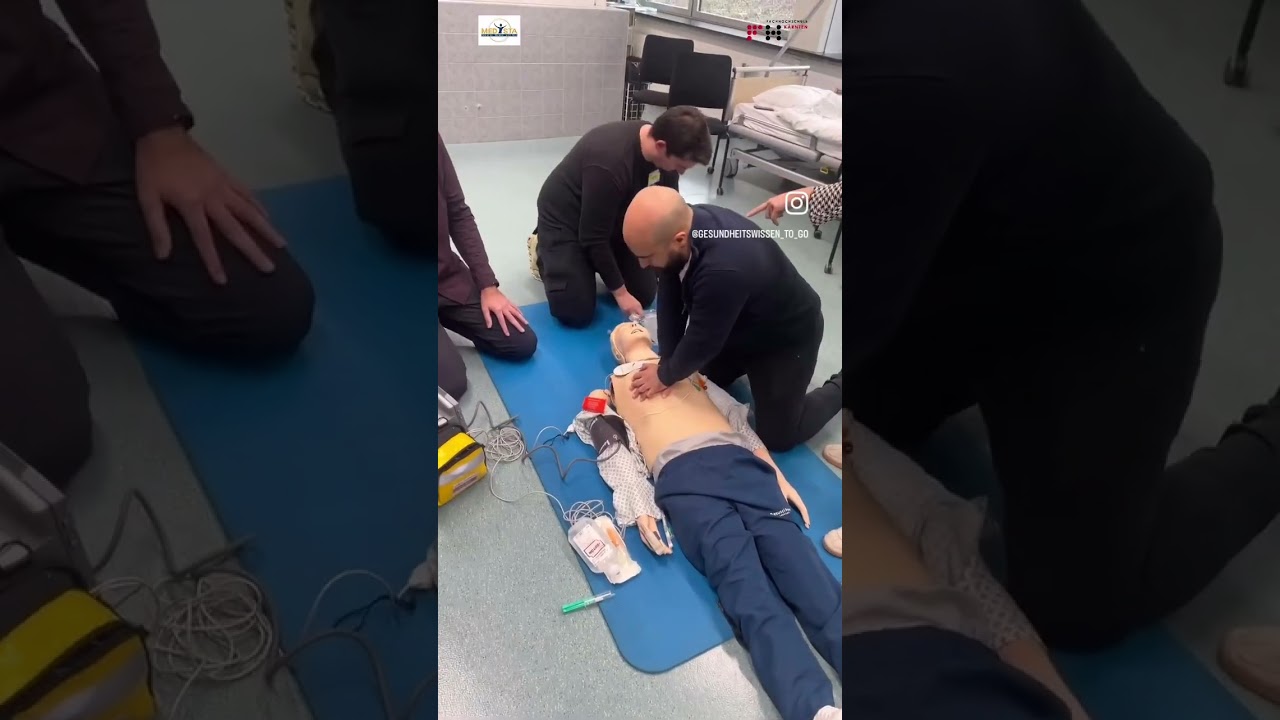
In the first semester (basic module), our students complete the ERC Advanced Life Support Course as part of their training! The Advanced Life Support (ALS) Course from the European Resuscitation Council (ERC) is a two-day multidisciplinary course that which prepares participants to identify the causes of cardiac arrest, recognize critically ill patients and manage
cardiac arrest as well as the peri-arrest phase. Here you’ll find recent reports from the ALS course at CU conducted by Med-STA.
The program is accredited as specialized training in intensive care in accordance with § 65 GuKG, as amended. The structure and content comply with legal requirements. Upon successful completion, you will receive the qualification “Academically Certified Expert in Intensive Care” and be authorized to perform specialized tasks in intensive care as well as to use the additional designation “Intensive Care.”
When every second counts, your skills make all the difference.
With a specialization in intensive care, deepen your knowledge to tackle challenging tasks in the intensive care unit.
Study Content and Areas of Focus
Who is this program intended for?
This program is primarily intended for mid-level healthcare and nursing professionals who are already working in intensive care and/or anesthesia nursing or who aspire to such a role.
To be admitted, you must have:
- a professional license for the higher civil service in health and nursing care or an equivalent, recognized international license as defined by the GuKG, as amended
- a completed pre-practicum in a specialized field in accordance with § 17 of the GuKG, as amended, or work experience in a specialized field
Basic knowledge of Word, PowerPoint and Excel is also recommended.
You'll focus on these key areas
The curriculum for the “Intensive Care Specialisation” program is divided into three areas: Nursing Specialization I and II (PflSG), Medical and Scientific Specialization (MEWISG), and Practical Training. These are divided into a basic module worth 30 ECTS credits and an advanced module worth 40 ECTS credits.
Intensive Care & Medical-Technical Skills
You will learn to monitor patients using state-of-the-art medical devices and to apply specific intensive care, medical-technical and nursing-therapeutic knowledge and skills in this specialized field.
Ethics, Communication, and Psychosocial Situations
You will explore ethical decision-making processes in the fields of intensive care and anesthesia nursing and learn to apply specific communication methods for patients and their caregivers. In addition, you will address the psychosocial situations of patients, family members and staff, as well as appropriate strategies for resolving them.
Nursing Science & Quality
You will participate in the implementation of nursing science findings in your specialized field and in nursing research projects. At the same time, you will learn to reflect on the quality of nursing practices and adjust them as needed.
Practicum & Course Format
In both the basic and advanced modules, you will complete 360 hours of clinically required internships. Internships are not possible within your own department but may take place at the main facility if opportunities arise. Courses are primarily conducted in in-person sessions with smaller blended-learning components.
After completing the course, you can work in these fields
As an academically certified expert in intensive care, you can apply your specialized nursing expertise in a variety of settings.
Specialty Departments & Intensive Care Units
Work in specialized departments or intensive care units across various medical disciplines in hospitals.
Mobile Intensive Care
Mobile care - including mobile intensive care - is also among the possible fields of practice.
Monitoring Units (IMCU) & Recovery Areas
Monitoring units (IMCU) and recovery rooms are another area of professional practice for intensive care specialists.


Info Box
Level of qualification
Academic Program
ECTS credits
70
Tuition fees
€ 7,200 Basic & Advanced Modules (70 ECTS for the entire program)
€ 3,750 Basic Module (30 ECTS)
ÖH (Austrian Student Union) fee
€ 26.20 / Semester
Qualification awarded
Academically Certified Expert in Intensive Care (AE Intensive Care)
Duration of study
2 Semesters
Language of instruction
German
CU Campus
Klagenfurt Mitte
A few spots are still available.
September 16, 2026 (based on a sufficient number of participants)
Dates - Intensive Care Basic Module 2026 (30 ECTS)
September 16, 2026 - January 29, 2027
Theory Sessions:
- September 16, 2026 - October 9, 2026
- November 9, 2026 - December 4, 2026
- January 25, 2027 - January 29, 2027
Practicum Sessions:
- October 12, 2026 - November 8, 2026 (160 hours of internship)
- December 7, 2026 - January 24, 2027 (160 plus 40 hours of internship; may include Christmas break or work on one’s own ward)
Dates - Advanced Module in Intensive Care Specialization 2026/27 (40 ECTS)
February 22, 2027 - July 2, 2027
Theory Blocks:
- February 22, 2027 - March 19, 2027
- May 3, 2027 - May 26, 2027
- June 28, 2027 - July 2, 2027 (including final exams)
Clinical Rotation Sessions:
- March 20, 2027 - May 2, 2027 (160 hours of internship + 40 hours of internship, possibly during Easter break or working on one’s own ward)
- May 31, 2027 - June 27, 2027 (160 hours)
Commissioned Audits:
There are two dates to choose from:
- June 28 through July 2, 2027
- September 2027
For your application, we need the following documents:
- Current resume with a photo
- Proof of completed training programs
- Proof of registration in the professional registry (professional license)
- Proof of identity (proof of citizenship or passport)
- Current confirmation of employment
- Cover letter
Credits may generally be granted for documented qualifications that exceed the admission requirements; such requests are reviewed on a case-by-case basis by the program administration.
FAQ
Frequently asked Questions about the Academic Program Intensive Care Specialisation
Who is this program intended for?
The program is designed for registered nurses who are already working in intensive care or anesthesia nursing or who would like to specialize in this field.
What degree will I receive?
Upon successful completion, you will receive the qualification “Academically Certified Expert in Intensive Care.” The program is accredited in accordance with § 65 GuKG and entitles you to perform specialized tasks in intensive care and to use the additional designation “Intensive Care.”
How long does the program take and can I attend it while working?
The program is designed to be work-friendly, lasts two semesters and is worth 70 ECTS credits. It is divided into a basic module (30 ECTS) and an advanced module (40 ECTS).
Campus
Klagenfurt Mitte
Virtual Campus Tour
On Foot
From Klagenfurt Central Station, you can reach the campus “Klagenfurt Mitte” in about 25 minutes on foot (2.5 km). The route takes you across the station plaza toward the city center and then along St. Veiter Straße to the grounds of the Klagenfurt Regional Hospital.
From the Heiligengeistplatz bus station, you can reach the campus in about 15 minutes (1.2 km) on foot. The route takes you along Wiesbadener Straße toward Neuer Platz, then continues along Kramergasse, Alter Platz, and Wiener Gasse to Heuplatz. From there, continue along St. Veiter Straße. After about 600 m, you’ll find the entrance to the Klagenfurt State Hospital grounds on your left.
The university building is marked as Building No. 24 on the Klagenfurt State Hospital map.
By public transportation
From Klagenfurt Central Station, you can reach the campus by taking line A or 4 to the “Morogasse” stop. From the station building, turn left toward the bus station.
Lines A and 4 also take you to the campus from the Heiligengeistplatz bus station.
By car
Coming from Villach or Wolfsberg, take the A2 Südautobahn and the Klagenfurt Nord bypass to the Klagenfurt Nord/Feldkirchen exit. Then follow Feldkirchner Straße toward the city. At St. Veiter Ring, turn left, and then turn left again at the intersection with St. Veiter Straße. After about 600 m, you’ll see the entrance to the Klagenfurt State Hospital grounds on your left. The university building is on the left.
Coming from St. Veit, you can reach the campus via the S37 Klagenfurt Expressway, which leads directly onto St. Veiter Straße. Follow the road until you reach the entrance to the Klagenfurt State Hospital grounds. Our university building is on the left.
By Plane
There are several airports in the area to choose from:
- Klagenfurt: approx. 10-minute drive
- Ljubljana (Slovenia): approx. 1 hour 10 minutes by car
- Graz: approx. 1 hour 30 minutes by car
- Salzburg: approx. 2 hours 30 minutes by car
- Trieste and Venice (Italy): approx. 2 to 3 hours by car
- Vienna: approx. 3 hours 30 minutes by car
- Munich: approx. 4-hour drive
The rest of the journey to the “Klagenfurt Mitte” campus is then made by train, bus, taxi, or car.
Contact

FH-Prof. Anita Mitterdorfer, MA M.Ed.
Program Director
+43 5 90500 3400
a.mitterdorfer(at)cuas.at

Mag.a Alexandra Liegl.
Head of CU Academy
+43 5 90500 4311
a.liegl(at)cuas.at

Mag.a (FH) Daniela Pluch
Manager of Educational Programs
+43 5 90500 4312
d.pluch(at)cuas.at