

Biomedical Science BSc - Bachelor's Program
Do you want to understand how diseases develop and how they are detected through laboratory tests? Are you interested in medicine, natural sciences and modern technologies? And do you want to use your knowledge to make a real contribution to health? Then the Bachelor’s program in Biomedical Science is just right for you.
With us, you’ll learn how to extract crucial information for diagnosis and treatment from blood, tissue, or DNA. You’ll work with state-of-the-art laboratory equipment, analyze medical samples and discover how research and innovation are shaping the medicine of tomorrow.
Are you looking for a meaningful career?
As a biomedical analyst, you’ll provide the results that clinicians rely on to make their decisions. Your work helps assess people’s health status, but above all, it helps detect diseases early, monitor treatments and thereby provide patients with the best possible care.
What can you expect from the Biomedical Analysis program, and how does it work here?
Here, you’ll develop scientific expertise, practical lab experience and the skills that are in demand in the healthcare sector today and in the future. From the very beginning, you’ll combine theory, lab exercises and professional internships. After graduation, many paths will be open to you: in hospitals, medical labs, research institutions, or industry. Biomedical analysts are highly sought-after professionals in Austria and throughout Europe.
Modern Laboratory Diagnostics
Your biomedical analyses can be crucial to saving lives, since 70% of all diagnoses are based on lab results.
Laboratory Practice
Starting as early as the first semester of the Bachelor’s program in Biomedical Analysis, you’ll gain practical experience in medical laboratories and get a firsthand look at everyday professional life in the healthcare sector.
Studying with Freedom
One Study & Work Day per week with no classes creates time for a part-time job, independent study, or personal activities. This makes it easy to organize your biomedical laboratory science program and balance it with your daily life.
Behind every diagnosis lies precise analysis.
In the Biomedical Science program, you’ll learn to use state-of-the-art laboratory techniques to lay the foundation for medical decisions.
Special Features of the Program
Innovative Curriculum
- From the basics to high-tech diagnostics: You’ll start with the fundamentals of medicine and gradually develop your skills in modern laboratory diagnostics.
- Broad diagnostic spectrum: You’ll explore topics including immunology, pathology, microbiology, molecular medicine, hematology, and screening procedures.
- State-of-the-art analytical methods: You’ll learn about both traditional and cutting-edge biomedical methods, including automation, quality assurance, and the management of point-of-care testing.
- More than just a lab: You’ll also gain skills in functional diagnostics, working directly with patients, and interprofessional collaboration.
Strong Practical Focus
- Hands-on experience from the start: With 35% of your coursework consisting of practical modules at the university and 25% consisting of professional internships, you’ll spend a significant portion of your studies where you’ll eventually work – in modern laboratories and healthcare facilities.
- Learning in a real-world professional setting: You’ll complete your internships in hospitals, institutes, laboratories, or research facilities.
- Flexible and personalized: You can choose your internship locations regionally or internationally, with practical training and vacation periods that can be planned to suit your individual needs.
- Optimally prepared: The close integration of theory and practice not only equips you with technical expertise but also builds your confidence and routine you’ll need for your future career.
Everyday Student Life
- Learning in small groups: Hands-on exercises take place in modern, well-equipped laboratories with personalized guidance (guaranteed lab space).
- Practical Instruction: Theory and hands-on lab work alternate continuously, providing you with optimal preparation for your future career.
- Systematic Examinations: Exams are held shortly after the courses and – depending on the module – include written exams, presentation exams, and practical assessments in the lab.
Study Abroad Opportunities
- Study Across Europe: As a student at CU Carinthia University of Applied Sciences, you are part of the ACE²-EU European University Alliance.
- Experience Europe: Take advantage of study abroad programs, summer schools, Blended Intensive Programs (BIPs), international project work, or internships at our partner universities.
- International Relations Office: We’ll help you plan your stay abroad (funding – e.g., ERASMUS – housing, university, internship).
Vaccination Recommendation
To complete the required professional internships in healthcare facilities, full vaccination coverage is required in accordance with the current vaccination recommendation issued by the Federal Ministry of Social Affairs, Health, Care, and Consumer Protection for healthcare personnel. This is to protect patients, fellow students, and staff. Students who cannot provide proof of the recommended vaccinations may not be assigned an internship or may only be assigned a limited number of internship placements, which could result in a longer duration of study. CU Carinthia University of Applied Sciences provides support in clarifying individual cases.
Details about the Program




Info Box
Level of qualification
Bachelor
ECTS credits
180
Tuition fees*
€ 363.36 / Semester
ÖH (Austrian Student Union) fee
€ 26.20 / Semester
Qualification awarded
Bachelor of Science in Health Studies
Duration of study
6 Semester
Language of instruction
German
CU Campus
Klagenfurt
Dates Info Box
Winterterm 2027
Period I: 01.11.-15.03.
Period II: 16.03.-15.05.*
*Application only for waitinglist. We reserve the right not to open the period or to close it early.
Winter semester starts in September. We only offer intake in winterterm!
The start of lectures can be found in the individual timetable which is available after enrollment.
Tuesday to Friday full-time and partly on Saturdays
An overview on our upcoming events can be found here.
You are interested in a personal (online) study consultation or would like to receive more information on the degree program? Click on the buttons below this checkbox to learn more.
Language of Instruction: German (min B2)
Application essentials:
More information on the application process, admission requirements and necessary documents can be found here.
* Tuition for non-EU/EEA citizens: €500 + €26.20 ÖH fee (per semester)
Highly Sought-After Experts in Laboratory Analytics — “Biomedicine is a very dynamic and highly complex field. This makes it all the more important that our graduates possess a solid foundation of knowledge and acquire in-depth technical and methodological skills that establish them as highly sought-after experts in laboratory analytics, enabling them to meet the professional demands placed upon them."
During my internship, I gained valuable experience. I particularly appreciated the supportive work environment, which allowed me to deepen my skills in practical application and histological preparation. I look forward to continuing to expand my knowledge and further my professional development.
It is very important to us to provide students with practical insight into the day-to-day work of a routine laboratory and to teach them the necessary skills, competencies, and specialized knowledge. Our interns have the opportunity to actively and independently participate to the daily operations of the departments of hematology, hemostasiology, clinical chemistry, immunology, and immunohematology. We, as a training institution, also benefit from our interns through the valuable input and feedback they provide.
Thanks to the hands-on education at CU Carinthia University of Applied Sciences and the laboratory experience they’ve already gained before starting their studies, career changers can be a great asset in the lab as early as their first professional internship.
Students in the Biomedical Science program at CU Carinthia University of Applied Sciences impress with their in-depth subject knowledge and practical skills. As a supervisor for bachelor’s theses at MedUni Graz, I’ve witnessed their independence and scientific curiosity. My goal is to inspire them to pursue innovative research and to foster their analytical thinking. The hands-on education at CU Carinthia University of Applied Sciences provides an excellent foundation for this.
FAQ
Frequently asked questions about the “Biomedical Science” Bachelor’s Degree
Is Biomedical Science the right fit for me?
Yes – if you enjoy working with precision and want to use your expertise to make an important contribution to medicine. Your analyses lay the foundation for diagnoses, treatments, prevention, and medical research.
How do you gain international experience?
As a student at CU Carinthia University of Applied Sciences, you are part of the ACE²-EU European University Alliance. You can participate in international projects, summer schools, blended intensive programs, internships, or study abroad programs at our European partner universities and gain valuable international experience.
What makes this profession so attractive?
The combination of medicine, people, and technology. You’ll work with state-of-the-art laboratory technology, interact with patients in the field of functional diagnostics, and support doctors and other healthcare professionals with precise analysis results.
Book an online information session
During the online information sessions, the program directors or academic directors provide detailed information about the program. Topics include course content, internships, admission requirements, and potential career prospects.

Prof. Marco Kachler,
BSc, LL.M. (University of Applied Sciences)
Deputy Head of the Academic Division, Program
Director for Biomedical Analysis
+43 5 90500 3530
m.kachler(at)cuas.at
INFORMATION & APPLICATION
Virtual Campus Tour
Contact

Sonja Nagelschmied, B.A.
Program
Administration +43 5 90500 3301
admin_gs_klu(at)cuas.at
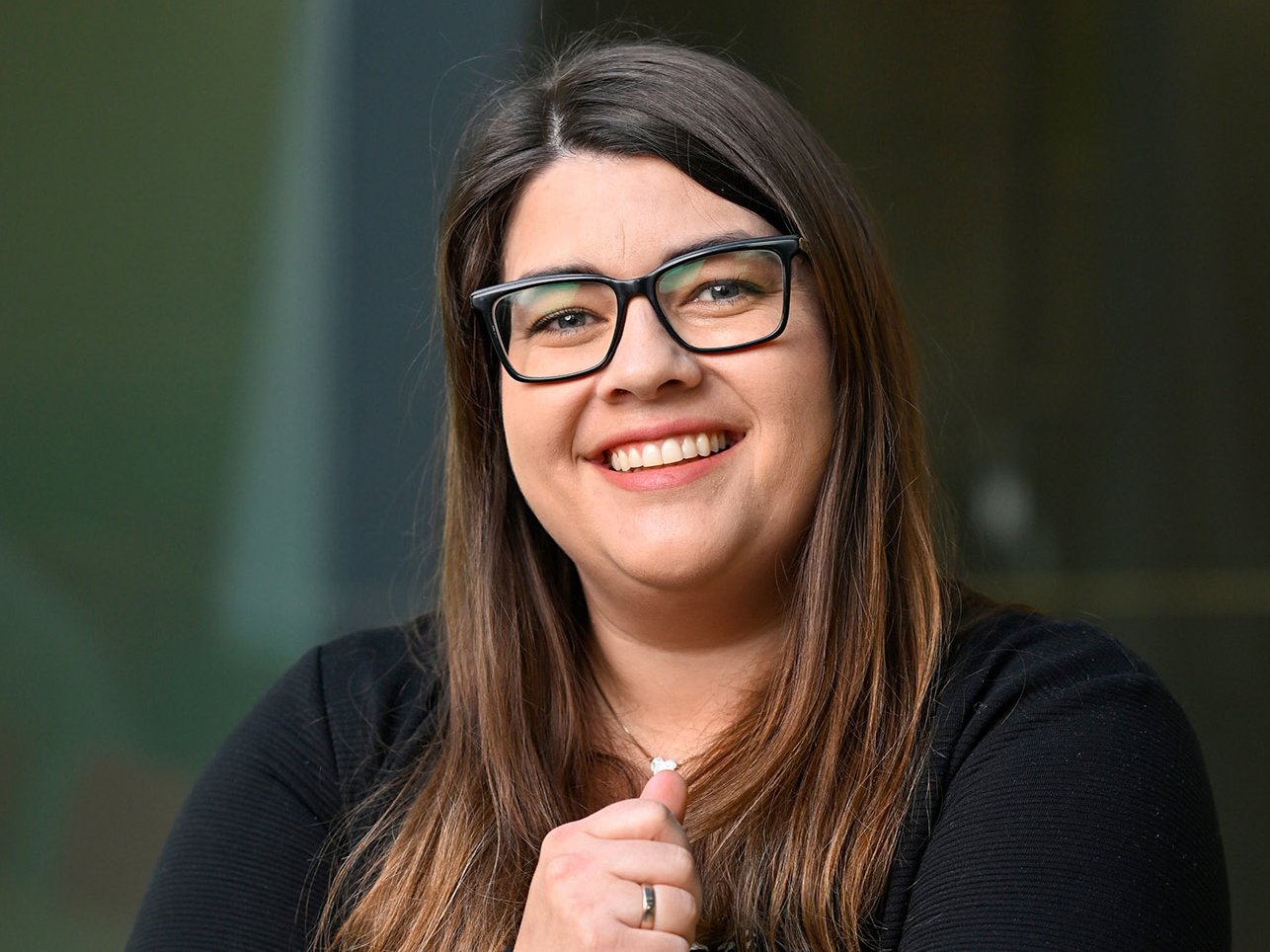
Tamara Stotter, B.A.
Program
Administration +43 5 90500 3501
admin_gs_klu(at)cuas.at
On Foot
From Klagenfurt Central Station, you can reach the campus “Klagenfurt Mitte” in about 25 minutes on foot (2.5 km). The route takes you across the station plaza toward the city center and then along St. Veiter Straße to the grounds of the Klagenfurt Regional Hospital.
From the Heiligengeistplatz bus station, you can reach the campus in about 15 minutes (1.2 km) on foot. The route takes you along Wiesbadener Straße toward Neuer Platz, then continues along Kramergasse, Alter Platz, and Wiener Gasse to Heuplatz. From there, continue along St. Veiter Straße. After about 600 m, you’ll find the entrance to the Klagenfurt State Hospital grounds on your left.
The university building is marked as Building No. 24 on the Klagenfurt State Hospital map.
By public transportation
From Klagenfurt Central Station, you can reach the campus by taking line A or 4 to the “Morogasse” stop. From the station building, turn left toward the bus station.
Lines A and 4 also take you to the campus from the Heiligengeistplatz bus station.
By car
Coming from Villach or Wolfsberg, take the A2 Südautobahn and the Klagenfurt Nord bypass to the Klagenfurt Nord/Feldkirchen exit. Then follow Feldkirchner Straße toward the city. At St. Veiter Ring, turn left, and then turn left again at the intersection with St. Veiter Straße. After about 600 m, you’ll see the entrance to the Klagenfurt State Hospital grounds on your left. The university building is on the left.
Coming from St. Veit, you can reach the campus via the S37 Klagenfurt Expressway, which leads directly onto St. Veiter Straße. Follow the road until you reach the entrance to the Klagenfurt State Hospital grounds. Our university building is on the left.
By Plane
There are several airports in the area to choose from:
- Klagenfurt: approx. 10-minute drive
- Ljubljana (Slovenia): approx. 1 hour 10 minutes by car
- Graz: approx. 1 hour 30 minutes by car
- Salzburg: approx. 2 hours 30 minutes by car
- Trieste and Venice (Italy): approx. 2 to 3 hours by car
- Vienna: approx. 3 hours 30 minutes by car
- Munich: approx. 4-hour drive
The rest of the journey to the “Klagenfurt Mitte” campus is then made by train, bus, taxi, or car.