
Study content and requirements
for the Industrial Engineering and Management program
Who is the bachelor's program in industrial engineering and management suitable for?
The WING program is the right choice for people who don’t want to choose one side over the other—neither pure technology nor pure business. If you want to combine both and grow as a person in the process, this is the right place for you.
Particularly suitable for:
- HTL and HAK graduates with a technical or business background who want to deepen their knowledge in both areas and aim for cross-functional and leadership roles in industry
- AHS graduates who find both technology and business equally interesting and are looking for an interdisciplinary degree program with a strong practical focus
- Working professionals with a technical or business background who wish to gain further qualifications and study while working
- People who view leadership not as a promotion, but as a personal development goal
- International students seeking an English-language engineering program with a strong business component and direct industry connections—the full-time track is taught in English, while the part-time track is taught in German
You don’t need to fit the traditional image of an engineer—but you do need the willingness to develop both technical and business mindsets simultaneously.
What do you need to start a degree in industrial engineering and management?
Formal Admission Requirements:
Austrian Matura (AHS, HTL, HAK, HLW, or equivalent), an equivalent foreign qualification for university admission, or the University Entrance Qualification Exam. No specific high school track is required.
Prior Knowledge:
Basic knowledge of mathematics and physics at the AHS level is helpful but not a requirement for admission. The program begins at a level that accommodates both AHS and HTL graduates equally. Programming skills are welcome but will be taught from the ground up.
Language Skills:
The language of instruction depends on the program format. The full-time track is taught in English, while the part-time track is taught in German.
Entry for HTL Graduates:
HTL graduates can shorten their IT bachelor’s program by up to one year if they have passed selected placement exams before the start of the program and have completed an HTL program in a relevant field. The admission requirement for entry into the 2nd or 3rd semester is a grade point average of 2 or higher in the last two annual report cards (4th and 5th year) from the HTL. Entry into the 2nd semester may be possible on an individual basis following a review of the applicant’s documents.
What can you do after you graduate?
Upon completion of the bachelor’s program in Industrial Engineering and Management, you will be able to:
- analyze and evaluate technical systems and production processes—and assess their economic implications
- plan, manage, and take responsibility for projects, from the initial idea through to implementation
- make business decisions based on technical considerations and, conversely, justify technical decisions from an economic perspective
- serve as a bridge between technical and business departments and present complex issues in a way that is understandable to both sides
- apply digital tools and methods of Industry 4.0, including artificial intelligence techniques in production
- Integrate generative AI specifically into problem-solving processes and evaluate its results critically, with an awareness of data protection, and responsibly
- Compare linear and circular economic models and integrate sustainability aspects into innovation processes
- Critically examine arguments, sources, and evidence, and derive well-founded judgments from them—including ethical considerations related to technical and economic decision-making
- work in a team and take on responsibility—using the communication and leadership skills specifically developed during the program
- Conduct scientific work, demonstrated through a bachelor’s thesis addressing a real-world problem from industry
Depending on your chosen specialization, you will also: In Industrial Engineering, you can design and operate cyber-physical production systems. In Sustainable Innovation Management, you can systematically design innovation processes, develop business models, and embed innovation initiatives within a company.
General Information About the Program
For more information on admission requirements, the training contract, nostrification and recognition, the admissions process, examination regulations and grading, ECTS credits, and the academic calendar, please refer to the General Study Information.
FAQ
Frequently Asked Questions About the Bachelor’s Program in Industrial Engineering and Management (BSc)
What makes WING special?
The Industrial Engineering (WING) bachelor program combines engineering with business administration and project management–ideal for anyone who wants to tackle technical and business challenges together.
How practical is the program?
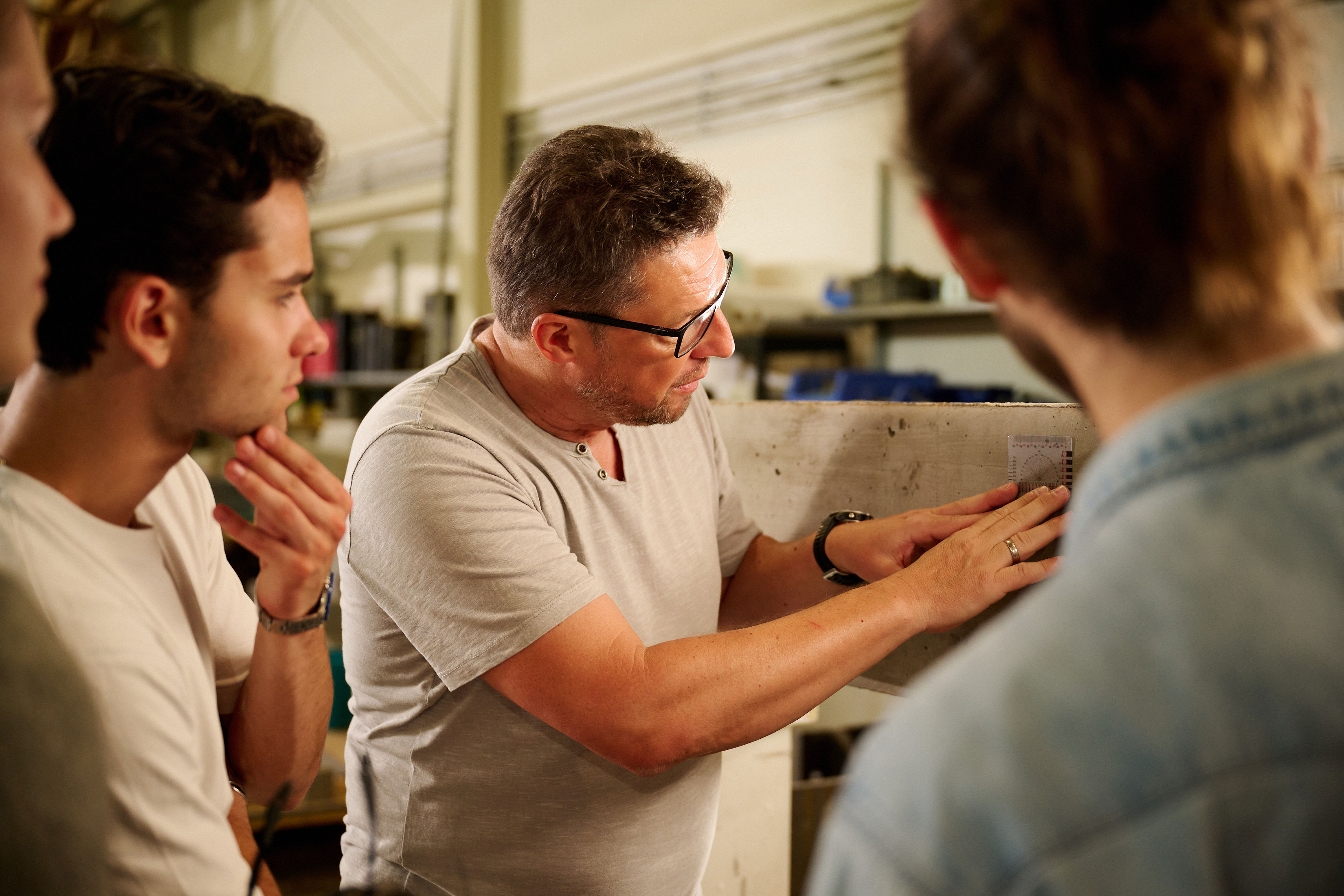
Practical experience is an integral part of the Industrial Engineering program: Through a required internship, real-world industry projects, and work in the Smart Lab and the Innovation Workshop, you’ll gain valuable experience and establish early connections with companies.
What career opportunities do I have?
A degree in industrial engineering opens the door to a wide range of career paths–from production and quality management to project and innovation management, and even technical purchasing. Alternatively, you can deepen your knowledge by pursuing a consecutive master’s degree in Industrial Engineering & Management.
Current Courses
Current course - Engineering and Management
Modular Structure of the Program
The bachelor’s program in Industrial Engineering and Management is divided into six semesters. The course content builds systematically on previous material–from technical and economic fundamentals to practical specialization and culminates in an independent bachelor’s thesis with an industry focus.
First Year of Study — Semesters 1 and 2: Laying the Foundation
In your first year of study, you’ll lay the groundwork: engineering mathematics, mechanics, applied physics, design, and materials science on the technical side, and the fundamentals of economics on the business side. You’ll also study manufacturing processes as well as the fundamentals of electrical engineering and measurement technology. Early group projects demonstrate how technical and business thinking are intertwined–not as two separate disciplines, but as a single way of thinking.
Second year of study — Semesters 3 and 4: In-Depth Study and Practice
In the third semester, students take courses in the fundamentals of computer science, machine elements, materials science 2, and business organization–and, with the module “Circular Economy and Innovation Management,” the theme that runs through the rest of the program. In the fourth semester, the focus is on production management, supply chain management, ERP systems, and the module “AI-Supported Problem-Solving Skills,” along with the first semester project, “Digitalization and Circular Economy,” conducted in collaboration with industry partners. You’ll apply what you’ve learned to real-world problems, not contrived case studies.
Starting in the third semester: your specialization
You choose one of two specializations and take three modules totaling 15 ECTS credits over the course of three semesters.
- Specialization in Industrial Engineering:
Automated Manufacturing Machinery and Industrial Robotics in the third semester, Cyber-Physical Systems in the fourth, and Cyber-Physical Production Systems in the fifth. You’ll learn to economically manage and further develop modern manufacturing systems–using machine learning, digital twins, and sensor technology. This track leads to careers in manufacturing, the automotive industry, and the semiconductor industry. - Specialization in Sustainable Innovation Management:
Systematic Innovation in the third semester with TRIZ and Value Management; Entrepreneurship and Business Model Development in the fourth; Innovation Organization and Intrapreneurship in the fifth. You’ll learn to systematically develop innovations, embed them within the company, and turn them into sustainable business models. The path to innovation management, product development, and entrepreneurship.
3rd year of study — Semesters 5 and 6: Advanced Study and Graduation
In the fifth semester, you will further deepen your knowledge in your area of specialization and supplement it with courses in quality management, controlling, and law, communication skills, and the “Personal Competencies” module. In addition, you will complete the second-semester project on “Digitalization and the Circular Economy.” The final semester consists of a professional internship at an industrial company, the “International Collaborations” module featuring a real-world use case, and the bachelor’s degree program, which includes a bachelor’s thesis, a bachelor’s seminar, and a bachelor’s exam.
Jobs & Careers
WING graduates are in demand wherever technical expertise and business acumen are needed: in the manufacturing sector, the service industry, and management consulting.
Typical entry-level positions
- Production Planner — Management and Optimization of Manufacturing Processes
- Project Engineer — Managing technical projects from concept to production readiness
- Quality Manager — Ensuring process and product quality in accordance with industrial standards
- Technical Buyer — Liaison between technical requirements and procurement
- Process Optimization Manager — Analyzing and improving production and supply chain processes
- Innovation Manager — Developing new products, processes, and business models
- Sustainability or Circular Economy Manager — Transforming products and processes toward a circular value chain
- Technical Sales Representative — Explaining complex products to customers and partners
- Entrepreneur in DeepTech and Industry 4.0 — Building a technology startup
Industries
Automotive and semiconductor industries (Infineon, Hella, Magna, AVL), mechanical engineering, energy technology, logistics, circular economy, management consulting, Industry 4.0, and startups.
With the WING Bachelor’s degree, you’ll be right at the starting line for the consecutive Master’s in Industrial Engineering & Management (IEM) at CU—without having to start over or change locations. The Master’s program is designed for working professionals and is taught in German, making it easy to combine with your career.
What comes after a bachelor's degree in industrial engineering and management?
Direct Continuation at CU: Master’s in Industrial Engineering & Management
The consecutive Master’s program in Industrial Engineering & Management (IEM) at CU Carinthia University of Applied Sciences is the natural next step. You’re already familiar with the environment, the faculty, and the campus, and you’ll continue your studies right where WING left off: leadership skills, smart production, innovation, and management at the master’s level. The master’s program is taught in German.
Other Master’s
Programs With a Bachelor of Science in Engineering, a wide range of technical and business-related Master’s programs in German-speaking countries are open to you.
Direct Entry into the Professional World
Many WING graduates enter the industry directly. The bachelor’s degree is a fully recognized qualification for bridge and entry-level positions.
Research You Can Experience Firsthand:
In the ongoing campAIgn and reCANet projects, faculty and students are working on AI-supported innovation processes and the circular economy in the electronics industry. Findings from these projects are directly incorporated into the curriculum.
Engineering or management? At WING at CU, you don’t have to choose – you can combine both.
6 semesters, 180 ECTS, real-world industry experience in Villach. Full-time or part-time.