

Study content and requirements
for the Occupational Therapy Program
What should you bring with you for your studies?
For the Occupational Therapy Bachelor’s Program, it is especially important to have an interest in health-related topics, enjoy working with people, and be willing to grow both professionally and personally. You should be open to closely observing and analyzing everyday activities and working with others to develop appropriate solutions. The following are particularly helpful:
- An interest in health, occupational therapy, and social participation
- Curiosity to observe, analyze, and reflect on sequences of actions
- Socio-emotional and psychological stability, as well as openness, commitment, and a sense of responsibility
- A willingness to learn and take on new challenges
- The ability to work independently as well as collaboratively with people and organizations across interdisciplinary boundaries
- Enjoyment of critical and creative thinking, design, and communication
What you will learn during your studies
In the Occupational Therapy Bachelor’s Program, you’ll acquire the professional, methodological, and practical skills needed to support people of all ages in their daily lives. You’ll learn to assess individual abilities and limitations, plan occupational therapy interventions, and evaluate their effectiveness. The focus is on your clients’ independence, functional capacity, and social participation.
Promoting Functional Capacity and Social Participation
You will learn to support clients in developing, maintaining or regaining their individual capacity for action in everyday life. In this way, you will help them to carry out meaningful activities as independently as possible and to participate in social life.
Analyzing Daily Activities and Preparing Assessments
You will assess your clients’ abilities, needs and limitations and analyse their everyday activities. Based on this, you will prepare an occupational therapy assessment, jointly agree on therapy goals, and plan appropriate interventions.
Implementing and Evaluating Occupational Therapy Interventions
You will learn to independently implement occupational therapy interventions and tailor them to the individual life and health situations of your clients. You will then review the results and refine the therapy as needed.
What opportunities will you have after you graduate?
With a Bachelor’s Degree in Occupational Therapy, a wide range of career opportunities is open to you. For example, you can work in hospitals, rehabilitation centers, social service agencies, health promotion and prevention programs, or in home-based care. Careers in research, development, and teaching are also possible. You can work as an occupational therapist either as an employee or as a freelancer.
If you’d like to further deepen your knowledge, you can pursue a Master’s Degree in Occupational Therapy, Health Sciences, or a related field. The specific options depend on the respective admission requirements of the college or university.
How the Program is structured
The Occupational Therapy Bachelor’s Program spans six semesters and is worth 180 ECTS credits. Classes are held full-day Monday through Friday and, in some cases, on Saturdays as well. The program is supplemented by five professional internships totaling 1,300 hours, which are an integral part of the curriculum.
You can find detailed information about the program structure and the practical training phases in our FAQs on the Occupational Therapy Bachelor’s program.
General information about the Program
For more information on admission requirements, training contracts, nostrification and recognition, the admissions process, examination regulations and grading, ECTS credits, and the academic calendar, please refer to the General Study Information.
FAQ
Frequently asked questions about the "Occupational Therapy" Bachelor's Degree
Who is suited for the Occupational Therapy program?
This degree program is designed for people who are interested in health, social issues, and working with people. Strong communication skills, empathy, creativity, and a willingness to reflect are essential qualities.
When do the internships start, and where do they take place?
The first internship phases begin as early as the third semester of the Occupational Therapy Program. Internships can be completed in hospitals, rehabilitation centers, outpatient clinics, educational and social service facilities, and other occupational therapy settings.
Who do occupational therapists work with?
Occupational therapists work with people of all ages and with a wide range of functional needs – from children and adolescents to working-age adults and older adults.
Current Courses
Current course - Occupational Therapy · Organisation form: Vollzeit
Blog & Newsletter @ Occupational Therapy

The CoFIT project – “Online Teaching: By Students, For Students” – was launched by nine students in the Occupational Therapy Program at CU Carinthia University of Applied Sciences, class of 2019, as part of the "Project Management and Presentation" course.
You can find all the details on our blog at blog.fh-kaernten.at/cofit

As part of our information offerings, the Occupational Therapy Program publishes a monthly newsletter featuring a variety of topics from different areas of occupational therapy: All program staff contribute content to ensure a broad range of topics. For more information, please visit our Ergo4You website: blog.fh-kaernten.at/ergo4you
Our Information Brochures
 Poster Series 2021–2024Poster Series 2021–2024
 2023 Poster Session2023 Poster Session
 Poster Series 2019–2022Poster Series 2019–2022
 Poster Series 2018–2021Poster Series 2018–2021
 Poster Collection 2016–2019Poster Series 2016–2019
 Poster Series 2015–2018Poster Series 2015–2018
 RockET 2.0 Project ReportGetting a Head Start After Graduation
 Herbal RecipesHerbal Recipes for Young and Old
 Green CareGreen Care
 COVID-19 CrisisThe COVID-19 Crisis from an Occupational Therapy Perspective
 Activity AnalysisActivity Analysis in Practice
 Intervention ManualThe Intervention Manual for the Pilot Project
 School Life Made EasyOccupational Therapy in Schools
 Professional InternshipInformation Brochure
 Ergo & AALThe Intersection of Occupational Therapy and AAL
 How to SurviveHow to Survive as an Occupational Therapist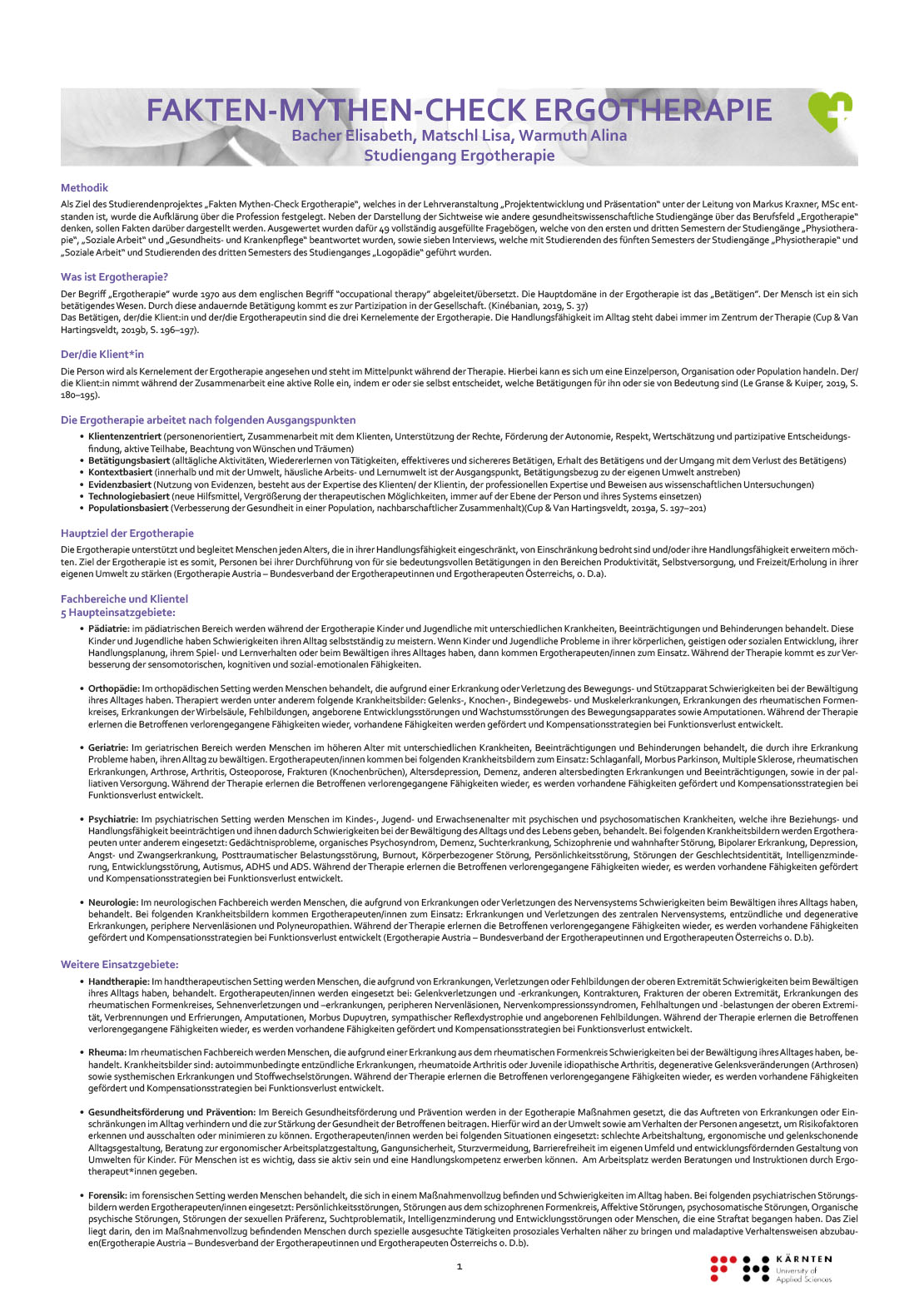
Are you interested in helping people on their journey toward greater independence?
Let’s break new ground together
Jobs & Careers
The Occupational Therapy Bachelor’s Degree Program opens up a wide range of career opportunities in the health and social services sectors. You’ll help people of all ages develop, regain, or maintain their ability to function in daily life. Your potential areas of work range from medical care and rehabilitation to prevention and health promotion. This degree qualifies you for both salaried and freelance work and lays the foundation for further specializations as well as a career in research and teaching.
Your career prospects after earning a Occupational Therapy Bachelor's Degree
As an occupational therapist, you work with people whose daily lives are limited due to illnesses, injuries, disabilities, or age-related changes. In this role, you plan and design individualized therapeutic interventions that promote independence, quality of life, and social participation. Thanks to the broad scope of your training, you can work in a variety of medical and psychosocial fields.
You can work in these areas
For graduates of the Occupational Therapy Bachelor’s Program, the following areas are particularly relevant:
- Pediatrics and developmental support
- Neurology and neurorehabilitation
- Orthopedics, rheumatology, and hand therapy
- Psychiatry and psychosocial care
- Geriatrics and Gerontology
- Rehabilitation and Follow-Up Care
- Health Promotion and Prevention
- Palliative Care
- Outpatient and Mobile Occupational Therapy
- Research, Development, and Teaching
Fields of employment
Depending on your field of study and personal specialization, you can work in various settings and roles. Typical career opportunities include:
- Occupational therapists in hospitals and clinics
- Occupational therapists in rehabilitation centers
- Occupational therapists in pediatric and adolescent therapy facilities
- Occupational therapists in neurological facilities
- Occupational therapists in psychiatric and psychosocial facilities
- Occupational therapists in nursing and senior care facilities
- Occupational therapists in outpatient therapy centers
- Mobile occupational therapists providing in-home care
- Freelance occupational therapists in private practice
- Research assistants and faculty members in the field of occupational therapy
Your development doesn’t stop after your Bachelor’s Degree
With your Bachelor’s Degree, you can enter the workforce immediately and work either as an employee or as a freelancer. At the same time, the degree program lays the foundation for further professional training and specializations. In addition, you can pursue a Master’s Degree in Occupational Therapy, Health Sciences, or a related field at a college or university.