
Study content and requirements
Advanced Practice in Diagnostic Imaging Degree Program
Here's what you'll learn during your studies
The program builds on the skills you acquired during your bachelor’s degree and your professional experience, and specifically develops them further over the course of five semesters. In the process, you’ll combine diagnostic expertise with quality, technology, science, and management.
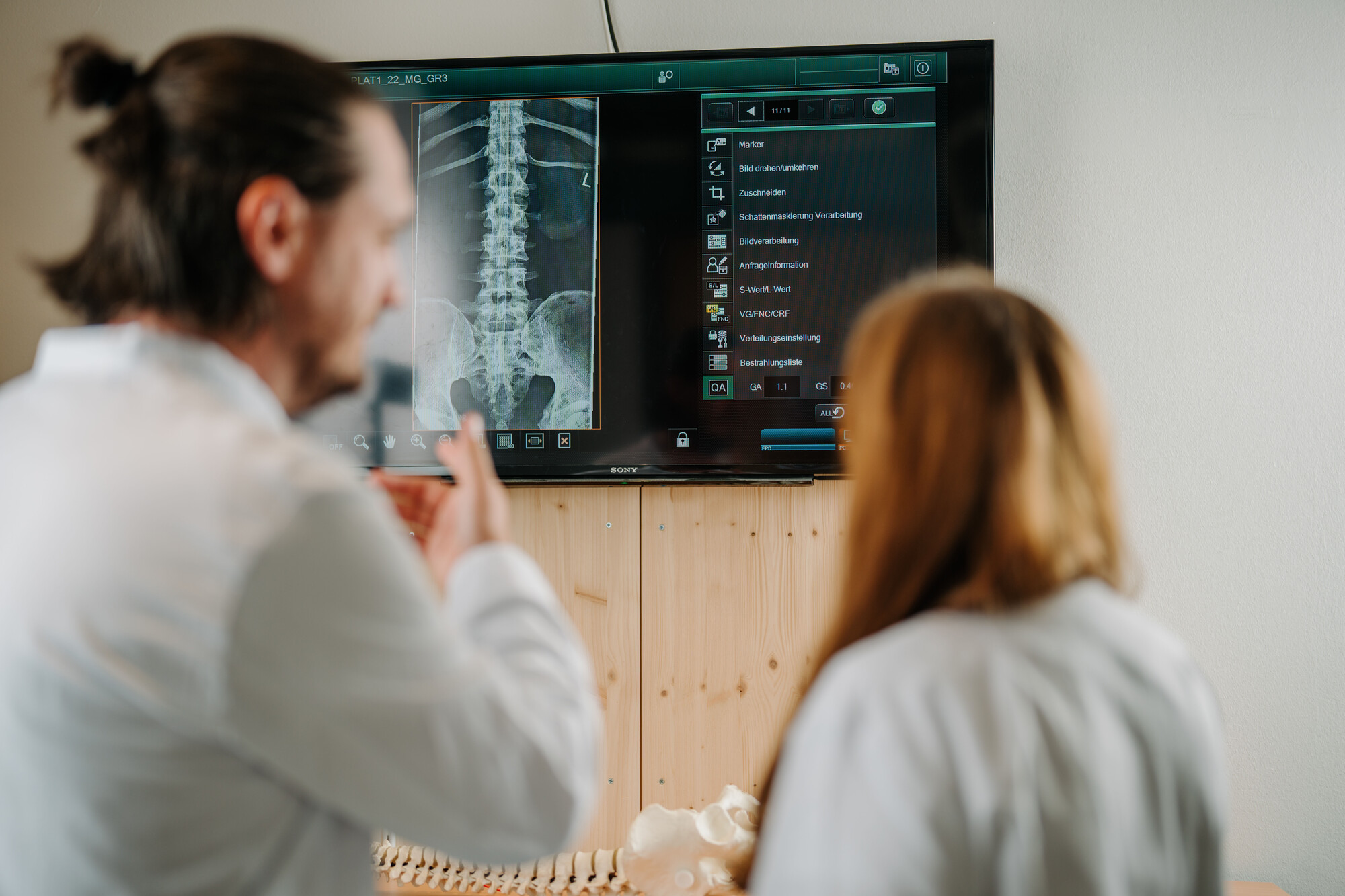
- Image Analysis and Report Writing: You will further develop your skills, ranging from the systematic analysis and interpretation of chest/lung, abdominal, and skeletal X-rays to the structured preparation of radiology reports. In the process, you’ll learn to describe and evaluate image quality and abnormalities in a nuanced way, incorporate clinical information, and assess its clinical relevance. As the program progresses, you will apply these skills to a variety of cases, in clinical case discussions, and during clinical rotations under the mentorship of specialist physicians.
- Quality and Patient Safety: Building on your prior knowledge, you will deepen your expertise in radiation protection and dose management. This is followed by quality management and technical quality assurance, as well as process and risk management. In this way, you will learn to systematically analyze factors influencing quality and patient safety and to derive optimization measures.
- Artificial Intelligence and New Technologies: You will first learn the fundamentals of artificial intelligence. Building on this, you’ll explore the possibilities and limitations of artificial intelligence in diagnostic radiology and learn to use AI-supported applications in a critical, transparent, and quality-oriented manner for image acquisition, image analysis, and report generation.
- Communication, Management, and Leadership: You will expand your skills in multi- and interprofessional communication, process and change management, leadership, and self-leadership. In doing so, you’ll learn to reflect on your professional role, help shape projects and processes, incorporate diverse competencies within a team, and advocate for decisions grounded in professional expertise.
- Science and Evidence-Based Practice: You will develop your scientific competencies, ranging from academic skills to evidence-based practice and research methods, all the way to planning and conducting your own research project. In your master’s thesis, you will ultimately work independently on a research question related to advanced practice in diagnostic imaging.
What You Should Bring
To be admitted to the program, you must hold a professional license as a radiologic technologist and a relevant college degree from a recognized domestic or foreign postsecondary educational institution. This includes, in particular, a bachelor’s degree in radiologic technology or an equivalent degree, such as one from a former academy for radiologic technology services in Austria, lasting at least 6 semesters.
If you have completed a two-year training program in radiologic technology, you must also have a relevant bachelor’s degree or an equivalent degree requiring at least six semesters of study, such as in medical technology, computer science, electrical engineering, educational sciences, or psychology. Comparable international degrees may also be recognized. The program director will determine the equivalence of other qualifications on a case-by-case basis. One year of relevant professional experience in conventional X-ray is advantageous but not a mandatory requirement. In addition, English proficiency at the B2 level and, if German is not your native language, German proficiency at the B2 level are required.
Here's how the program is structured
The five-semester master’s program is designed to be taken while working and combines approximately 70% online instruction with 30% in-person instruction. Online courses generally take place on Tuesdays, Wednesdays, and Thursdays from 5:00 p.m. to 9:00 p.m. In-person instruction takes place in blocks lasting several days, from Thursday through Saturday, at the Mitte Campus in Klagenfurt (three blocks from the first through the third semester and four blocks in the fourth semester). The fifth semester focuses on the master’s thesis and the master’s examination. Supervision appointments are arranged individually. In the fourth semester, you’ll complete a two-week internship at a radiology facility. In addition, the independent analysis and documentation of patient cases throughout the course of study—beginning at the end of the second semester—is an ongoing component of the program. You should take this case work into account when planning your study schedule.
Further Studies
Upon successful completion of the master’s program, a wide range of opportunities for professional and academic advancement will open up to you. For example, you can pursue a doctoral program and further deepen your knowledge in research and academia. At the same time, the program qualifies you for challenging roles in diagnostic radiology as well as for positions in development, management, and teaching.
General Information About the Program
For more information on admission requirements, the training contract, nostrification and recognition, the admissions process, examination regulations and grading, ECTS credits, and the academic calendar, please refer to the General Study Information.
Current Courses
Current course - Advanced Practice in Diagnostic Imaging · Organisation form: berufsbegleitend (German)
Ready to take the next step in your career as a radiologic technologist?
Continue to develop your expertise in diagnostic radiology and open up new opportunities for yourself in clinical practice, research, and management.
Jobs & Careers
With the Master’s Degree in Advanced Practice in Diagnostic Imaging, you’ll expand your career opportunities as a radiologic technologist in diagnostic radiology at hospitals, radiology practices and institutes, outpatient clinics, and other healthcare facilities. You’ll gain the qualifications needed to take on more specialized tasks and will be able to help further develop diagnostic processes, ensure the quality of imaging, and support interprofessional teams.
Advanced Roles in Diagnostic Radiology
Use your in-depth expertise in image analysis and interpretation to systematically identify abnormalities on conventional chest/lung and skeletal X-rays and assess their clinical significance. In doing so, you will support the prioritization of urgent examinations and the radiological diagnostic process. By preparing structured radiologic technology reports, you can document your assessment in a transparent manner and make it available for further specialist evaluation. In doing so, you serve as a key liaison between radiologic technology and specialist diagnostics.
Quality Management, Technical Quality Assurance, and Patient Safety
Take on responsibility for technical quality assurance, quality management, and patient safety in your professional setting. You will plan, coordinate, and evaluate quality assurance measures, further develop existing processes, and contribute to the sustainable improvement of diagnostic procedures. With your expertise in image quality, radiation protection, and dose, process, and risk management, you’ll identify opportunities for optimization and play an active role in ensuring safe, high-quality patient care.
Helping to Shape New Technologies and AI in Diagnostic Radiology
Contribute your expertise in radiological technology to the implementation and evaluation of innovative technologies and AI-powered applications. You will be able to professionally assess their use in a clinical context, taking into account opportunities, risks, and ethical considerations. In this way, you will make an important contribution to the quality-oriented and responsible integration of innovative solutions into radiology processes.
Strengthening Teams and Actively Shaping Development
Use your skills in communication, project management, and leadership to successfully guide change. Together with your team, you’ll develop solutions to new challenges and support their practical implementation. Even without a formal leadership role, you can initiate development processes, bring together different perspectives, and actively promote innovation. At the same time, you’ll gain the skills needed for leadership and management roles in the healthcare sector.
Get Involved in Research and Development
Participate in research and development projects in diagnostic radiology and address clinically relevant questions using scientific methods. You can apply evidence-based findings to clinical practice and implement your own projects to advance the field of radiological technology. By participating in professional networks, professional associations, and national and international healthcare projects, you will actively contribute to scientific exchange and the advancement of the profession.
Applying expertise beyond clinical practice
Your expertise also opens up career opportunities beyond direct patient care. These include, for example, roles in the medical device and healthcare industries, in specialized services in the areas of technical quality assurance, radiation protection, or dosimetry, as well as in education, continuing education, and professional development. Depending on your field of work, you can apply your skills either as an employee or through self-employment or freelance work.
Applying expertise outside of clinical practice
Your expertise also opens up career opportunities beyond direct patient care. These include, for example, roles in the medical device and healthcare industries, in specialized services in the areas of technical quality assurance, radiation protection, or dosimetry, as well as in education, continuing education, and professional development. Depending on your field of work, you can apply your skills either as an employee or through self-employment or freelance work.