
Study content and requirements
for the Radiologic Technology Program
What should you bring with you for your studies?
Radiologic Technology combines medical expertise, modern medical technology, and working with people. If you’re interested in scientific concepts, enjoy taking on responsibility, and work carefully, you have what it takes to succeed in this program.
The following qualities are particularly helpful for your studies:
- A strong interest in medicine and modern medical technology
- A passion for working with people and empathy
- Strong communication skills and a team-oriented attitude
- Spatial reasoning
- Ability to work independently and take initiative
- Problem-solving skills and flexibility
- A sense of responsibility and a willingness to continuously develop and learn new things
- Good German language skills (Level B2/C1) and English language skills at Level B2
What you will learn during your studies
Professional Use of Imaging
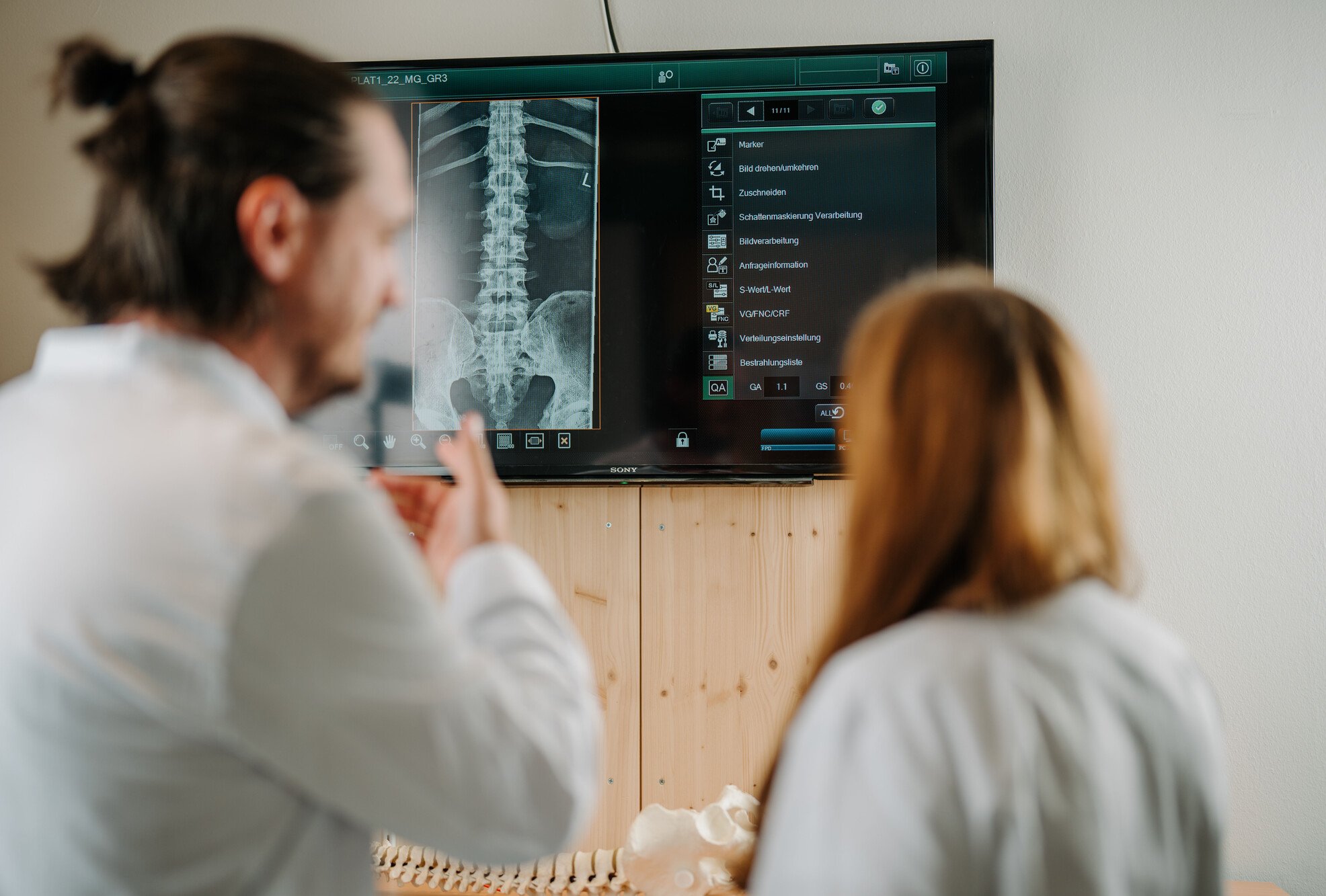
You’ll learn how to safely use modern imaging techniques – from projection radiography to computed tomography (CT), magnetic resonance imaging (MRI), ultrasound, and mammography, all the way to fluoroscopy-guided examinations. In the process, you’ll prepare for examinations, perform them properly, and learn to analyze and process image data professionally.
Supporting Diagnostics and Therapy
Radiologic technologists support patients not only during diagnostic examinations but also during therapeutic procedures. During your studies, you’ll explore nuclear medicine, molecular imaging, and radiation therapy. At the same time, you’ll learn to provide competent care to patients and adhere to the highest standards in radiation protection, dosimetry, and patient safety.
Using Medical Technology Safely
You’ll work with modern medical technology and digital information and communication systems. This includes, among other things, digital image processing, image post-processing, and technical quality assurance. In this way, you’ll develop the skills to perform radiological examinations and therapies with technical confidence and a focus on quality.
Working Scientifically and Interprofessionally
In addition to technical expertise, you will develop scientific, communication, and interpersonal skills. You’ll learn to work scientifically, engage with current issues in radiology technology, and write your Bachelor’s thesis. At the same time, you’ll practice professional communication, interprofessional collaboration, and responsible interaction with patients and other healthcare professionals.
Combining Theory and Practice
The Program combines theoretical foundations with practical exercises in the SkillsLab RT and extensive professional internships. Early on, you’ll apply your knowledge in realistic learning situations and gradually gain experience in everyday clinical practice.
Here's how your educational journey continues
The Bachelor’s Program in Radiologic Technology lays the foundation for your future professional and academic development. If you’d like to deepen your expertise in diagnostic imaging and take on more advanced clinical responsibilities, CU Carinthia University of Applied Sciences offers a part-time Master’s program in Advanced Practice in Diagnostic Imaging.
The Master’s Program qualifies radiologic technologists for specialized roles in diagnostic imaging. You’ll deepen your expertise in areas such as structured image analysis and interpretation, quality assurance, process optimization, and the use of Artificial Intelligence in radiology. In addition, the program prepares you for research, development, and management roles.
General information about the Program
For more information on admission requirements, the training contract, nostrification and recognition, the admissions process, examination regulations and grading, ECTS credits, and the academic calendar, please refer to the General Study Information.
FAQ
Frequently asked questions about the "Radiologic Technology" Bachelor’s Degree
Is the radiation dangerous to me?
During your studies, you will learn exactly how to use radiation safely and responsibly. Through technical safeguards, clear safety rules, and consistent radiation protection measures, occupational radiation exposure is kept to a minimum.
Are there any online courses?
Yes. Individual courses or course content may be offered online. However, since Radiologic Technology is a very hands-on program, many exercises and practical sessions are conducted on campus.
Does Radiologic Technology have anything to do with radios?
No. Despite the name, the program has nothing to do with radios or “radio technology.” Radiologic technologists are not radiologists, nor do they belong to the field of health care and nursing. Radiologic Technology is an independent, scientifically based health discipline with a focus on medical imaging, radiation therapy, and nuclear medicine.
Current Courses
Current course - Radiologic Technology · Organisation form: Vollzeit
Medicine or technology? Why not both?
In the Radiologic Technology Bachelor’s Program, you’ll combine medical expertise with state-of-the-art medical technology and gain valuable hands-on experience right from the start. Apply now for your spot in the program.
Jobs & Careers
Radiologic technologists make an important contribution to medical care. They work with state-of-the-art medical technology, assist patients, and support medical staff in preventive care, diagnostics, and treatment. Thanks to medical advances and the growing demand for imaging exams and therapeutic procedures, a wide range of career and development opportunities are opening up in the healthcare sector.
Here's what to expect in your day-to-day work life
As a radiologic technologist, you independently perform radiologic examinations and therapeutic procedures. You prepare patients for examinations, assist them throughout the entire process, and ensure the safe and professional use of modern medical technology. At the same time, you process image data, ensure compliance with radiation safety and quality standards, and work closely with medical staff and other healthcare professionals. Depending on your area of practice, you may also contribute to the further development of radiological procedures or participate in research projects.
A wide range of development opportunities
After completing your degree, you can specialize in various fields. These include, among others, diagnostic radiology, computed tomography (CT), magnetic resonance imaging (MRI), mammography, interventional radiology and angiography, nuclear medicine, and radiation therapy. In addition, you’ll have opportunities to work in research, teaching, or medical technology.
Fields of employment
Radiologic technologists are in demand in nearly all areas of the healthcare sector. These include hospitals, university medical centers, radiology institutes, and diagnostic centers, as well as specialist medical practices, centers for nuclear medicine and radiation therapy, and rehabilitation and healthcare facilities. Research institutions, universities, and medical technology companies also offer attractive career prospects.