Study content and requirements
Green Transition Engineering degree program
What should you bring to the program?
To be admitted to a bachelor's degree program at CU Carinthia University of Applied Sciences, at least one of the following criteria must be met:
- General university entrance qualification (Austrian high school diploma or an equivalent foreign diploma)
- Vocational Maturity Examination
- Subject-specific university entrance qualification
- Subject-specific vocational qualification (subject-specific apprenticeship certificate or graduation from a vocational secondary school with a program of at least three years) with additional exams
Since Green Transition Engineering is an English-language program, we require English proficiency at the B2 level.
When you apply, your documents will be reviewed for suitability and completeness. If you are in your final year of high school, you can apply for a spot in the program even before taking your Matura exam by submitting your current annual report card. You must submit your high school diploma after successfully completing the admissions process and before the start of the academic term.
You can find more general information about the application and admission process in the Info Center at CU Carinthia University of Applied Sciences.
International students must pay special attention to certain requirements when applying. Please refer to the “What You Need to Know About Applying” section in the Info Center at CU Carinthia University of Applied Sciences.
Here's how the program is organized
The Green Transition Engineering bachelor’s program spans six semesters and is worth 180 ECTS credits. It is offered as a full-time, English-language program at the Villach campus. Courses are primarily held on campus and are supplemented by field trips and outdoor exercises.
You can organize some of your independent study and group work flexibly. Classes may take place Tuesday through Friday between 8:30 a.m. and 8:00 p.m. and on Saturdays between 8:30 a.m. and 4:00 p.m.
What opportunities will you have after you graduate?
With a bachelor’s degree in Green Transition Engineering, you can apply to CU Carinthia University of Applied Sciences for the master’s program in Applied Data Science or the professional master’s program in Management of Conservation Areas. This will allow you to deepen your knowledge in data analysis or sustainable conservation area management.
You also have the option of pursuing comparable master’s programs at other universities of applied sciences and universities. Admission is subject to the respective admission requirements of the program you choose.
General information about the program
For more information on admission requirements, the training contract, nostrification and recognition, the admissions process, examination regulations and grading, ECTS credits, and the academic calendar, please refer to the General Study Information.
FAQ
Frequently asked questions about the
“Green Transition Engineering” Bachelor’s Degree Program
How long does the program last, and what degree will I receive?
The program lasts 6 semesters and comprises 180 ECTS credits. Upon successful completion, you will receive the academic degree Bachelor of Science in Engineering (BSc).
In what language are the courses taught?
The entire program is taught in English. To be admitted, you must have English proficiency at least at the B2 level.
Do I need any prior technical knowledge or programming skills?
Programming skills are not a prerequisite; the necessary fundamentals are taught step by step during the program.
Current Courses
Current course - Green Transition Engineering · Organisation form: Vollzeit (English)
Modular Structure
of the Green Transition Engineering program
The modules and courses are designed to focus on students' acquisition of competencies. A variety of learning activities, including both on-campus and off-campus sessions, are combined with individual or group activities to promote self-directed learning.
Academic Year
The program begins with the “Orientation and Outdoor Project” module. During this module, you’ll get to know your fellow students, reflect on your expectations, set goals for yourself, and work on a practical case study directly in the field. You’ll learn how digitalization and data technology contribute to solving specific problems.
At the same time, you’ll acquire fundamental skills in the following areas:
- Methodological and Scientific Foundations
- Social Transition
- Ecological Transition
- Data Engineering
Academic Year
In your second year of study, you’ll deepen your knowledge in the following areas:
- Social Transition
- Economic Transition
- Ecological Transition
- Technological Transition
- Data Engineering
In doing so, you’ll integrate these areas of focus in an interdisciplinary manner and apply your knowledge to specific fields of application. In the 4th semester, you’ll begin the “Interdisciplinary Project.” Working as part of a team, you’ll tackle real-world tasks, deepen your technical skills, and gain experience in project management.
Academic Year
In your third year of study, you’ll deepen your knowledge in practical fields of application. In the “Interdisciplinary Project 2” module, you’ll continue your project work and present your findings.
In the fifth semester, you’ll choose four required-elective modules based on your interests. The sixth semester includes a 12-week mandatory internship in Germany or abroad, as well as your bachelor’s thesis, which often builds on the interdisciplinary project. The program concludes with the bachelor’s exam.
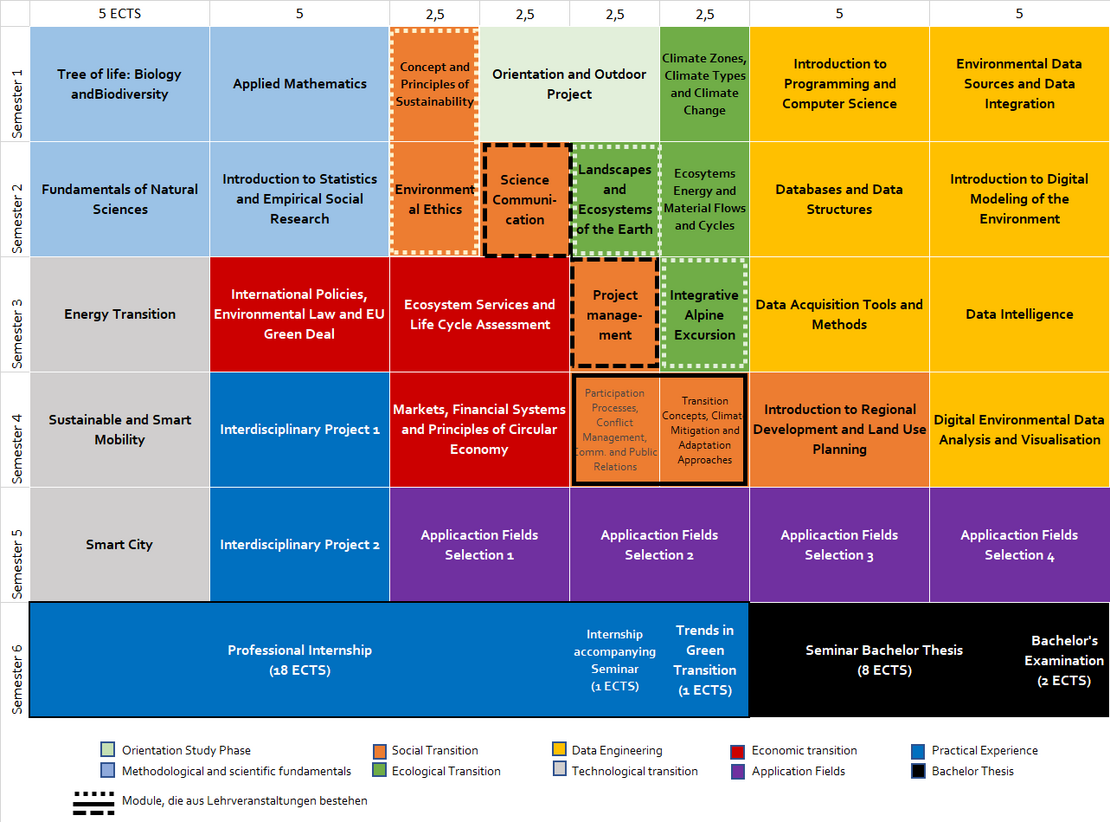
The Green Transition Engineering bachelor's program is divided into six areas of specialization. These combine the natural sciences, sustainability, technology, data analysis, economics, and social transformation.
Are you ready to revolutionize the environment through technology?
Let’s drive the green transformation forward together.
Skills Profile and Career Opportunities
With a bachelor’s degree in Green Transition Engineering, you’ll have career opportunities in nearly all sectors of the economy, as well as in research, consulting, and public administration. Professionals who coordinate sustainability projects, support transformation processes, and evaluate measures are in particularly high demand.
An Education That Sets You Up for the Future
As a graduate of the Bachelor’s program in Green Transition Engineering, your broad education in the areas of green transition, data engineering, and digitalization will ensure you’re well-prepared for the future. Sustainability and digitalization are increasingly shaping all areas of life and work—whether in business, politics, or society. With your knowledge, you’ll help achieve the sustainability goals of the European Union and the United Nations.
Your Skills Profile
You will gain:
- Specialized foundational knowledge in ecology, climate change, transformation processes, renewable energy, and transportation.
- The ability to view global sustainability goals holistically and apply them to regional issues.
- Data literacy: collection, storage, processing, integration, interpretation, and visualization of environmental and climate data.
- The ability to make, communicate, and document evidence-based decisions regarding sustainability measures.
- The ability to address subject-specific issues at the bachelor’s level.
Your Career Fields
Sustainability is in demand in nearly every industry today. After you graduate, you can pursue a career in the following fields, for example:
- Business: Audit firms, banks, consulting, energy consulting, large corporations, engineering firms, marketing, and public accounting
- Research & Development: Research institutions, research-oriented companies, as well as clusters and networks
- Public Sector & NGOs: Public administration (environmental protection and conservation), advocacy groups, and nongovernmental organizations
- Specialized Roles: Climate protection officer, sustainability officer, project coordination, process consulting, reporting, and interface management
The European Green Deal is creating new job profiles and fields of work—particularly in data handling, monitoring, and the implementation of sustainability measures. Your skills in digitalization and data management make you a highly sought-after professional.
Research & Practice
In the Green Transition Engineering program, you’ll work on real-world project topics right from the start. You’ll learn to work precisely and in a solution-oriented manner as part of a team, hone your judgment, and contribute to development processes. The projects are developed in close collaboration with faculty members, researchers from the ICEB Research Center, and partner organizations. ICEB experts teach in the program, ensuring that current research topics are directly integrated into the curriculum.