

Study content and requirements
for the Business Development & Management degree program
What should you bring to the program?
You’re interested in economic developments and want to play an active role in shaping the growth of companies. The Master’s program in Business Development & Management is designed for individuals who want to identify new business opportunities, develop innovative solutions, and take on leadership roles in interdisciplinary teams. The following are particularly helpful:
- An interest in economic and strategic issues
- A passion for developing new ideas and business models
- Analytical thinking and the ability to grasp complex relationships
- Teamwork skills and a willingness to take on responsibility
- Strong language and communication skills
- Responsible and socially conscious behavior
- Interest in international and intercultural challenges
For admission, you must have completed a relevant bachelor’s or diploma program—or an equivalent program—at a recognized domestic or foreign postsecondary educational institution.
Here's what you'll learn during your studies
During your studies, you’ll deepen your expertise in key business functions and learn to independently tackle complex tasks in business development and other specialized areas. In particular, you’ll analyze trends in sustainability and digitalization to identify opportunities for qualitative and quantitative business growth and use these insights to develop growth and development strategies.
You will develop new business models, identify target audiences and business segments, and support the development and market launch of new products and services. In addition, you’ll help create the internal conditions for growth, strengthen your social, communication, and language skills, and learn to lead interdisciplinary project teams and develop solutions for cross-functional challenges.
What opportunities will you have after you graduate?
With a master’s degree in Business Development & Management, you can support companies in their strategic development and take on responsibility for growth, innovation, and change processes. Your skills are in high demand at companies across various industries as well as at consulting firms.
This degree qualifies you for positions of responsibility in specialized roles, project management, and leadership within companies across various industries as well as in consulting firms.
Here's how the program is organized
The master’s program is designed to be compatible with a full-time job. Online classes take place on Wednesdays and Thursdays starting at 4:50 p.m. On Fridays, classes begin at 1:30 p.m. and are held online twice a month and in person on campus twice a month. In addition, an on-campus week is scheduled at the beginning of each semester. There are no classes on weekends.
General Information About the Program
For more information on admission requirements, the training contract, nostrification and recognition, the admissions process, examination regulations and grading, ECTS credits, and the academic calendar, please refer to the General Study Information.
FAQ
Frequently asked questions about the Master’s Degree Program in
“Business Development & Management”
What is business development?
Business Development identifies and taps into new growth opportunities for companies. These include new customer groups, markets, products, sales channels, and business models.
What does a business developer do?
Business developers analyze markets, identify opportunities, and develop new business opportunities for companies.
What requirements do I need to meet?
A relevant bachelor’s degree, diploma, or equivalent college degree is required. Suitability is assessed during the admissions process.
Current Courses
Current course - · Organisation form: Vollzeit
Curriculum Structure
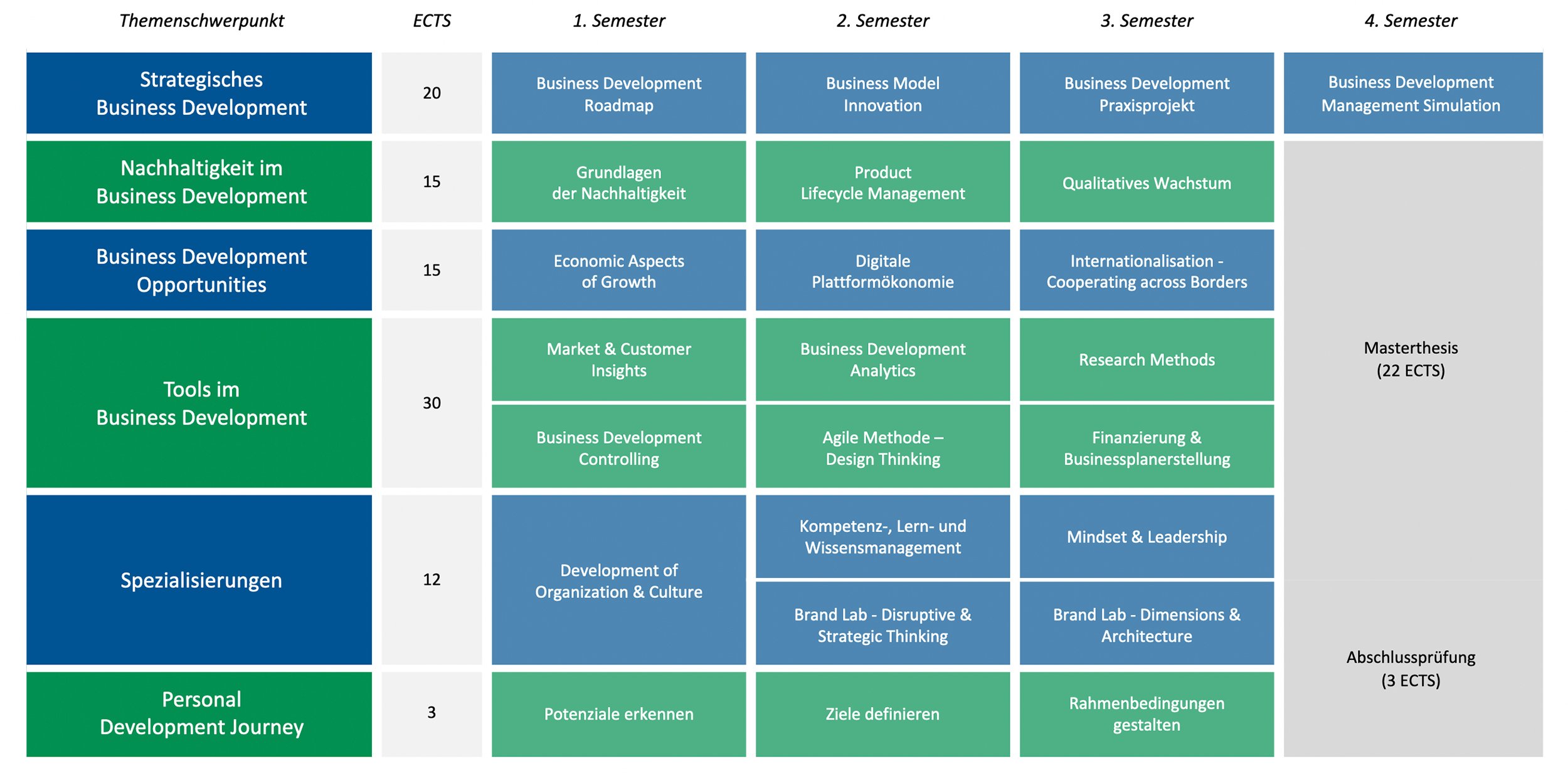
During the first three semesters of the program, students must complete 6 modules in each semester, each worth 5 ECTS. The fourth semester is primarily reserved for the master’s thesis (22 ECTS) and the final exam (3 ECTS); in addition, the module “Business Development Management Simulation” is offered during this semester. Students may also complete the optional semester abroad during the fourth semester.
The modules are grouped into six key topics based on their content:
- Business Development Roadmap (1st Semester)
- Business Model Innovation (2nd Semester)
- Business Development Practical Project (3rd Semester)
- Business Development Management Simulation (4th Semester)
- "Fundamentals of Sustainability" (1st semester)
- Module “Product Lifecycle Management” (2nd semester)
- Module “Qualitative Growth” (3rd semester)
- "Economic Aspects of Growth" (1st semester)
- "Digital Platform Economics" (2nd Semester)
- “Internationalization – Cooperating Across Borders” (3rd semester)
- Market & Customer Insights (1st Semester)
- Business Development Controlling (1st Semester)
- Business Development Analytics (2nd Semester)
- Agile Methods – Design Thinking (2nd Semester)
- Research Methods (3rd semester)
- Financing and Business Plan Development (3rd Semester)
(1 required module and 4 elective modules, from which 2 must be selected, i.e., 15 ECTS)
- Required module:
- Development of Organization & Culture (1st semester)
- Elective module in the Brand Management specialization
- Brand Lab – Disruptive & Strategic Thinking (2nd semester)
- Brand Lab – Brand Dimensions & Architecture (3rd semester)
- Elective Modules in the “Sustainable Organizations” Specialization
- Competency, Learning, and Knowledge Management (2nd Semester)
- Mindset & Leadership (3rd Semester)
(in conjunction with the modules in the Brand Management & Sustainable Organizations concentration, 3 ECTS)
- Part 1: Identifying Potential (1st Semester)
- Part 2: Defining Purpose (2nd semester)
- Part 3: Shaping the Framework (3rd semester)
Learning paths
Every student brings a unique set of experiences, interests, and career goals to the program. The learning paths build on these and help you further develop your existing strengths, set new priorities, and strategically expand your personal skill set.
 Sustainability & Business DevelopmentSustainability and growth strategies? There's no contradiction.
 Controlling & Finance in Business DevelopmentLinking Business Development and Controlling.
 Strategic Management & Business DevelopmentDeveloping sustainable and successful growth strategies.
 Organizational and Business Sustainability DeAdaptability, innovation, and sustainability.
 Digitalization & Business DevelopmentAI is revolutionizing industries and changing the way we work.
 Brand Management & Business DevelopmentThe brand as a company's most important investment.
Strategically Develop the Company
You identify business opportunities, develop viable strategies and business models, and oversee their implementation.
Strategic Management
Identifying Growth Opportunities and Developing Strategies
You will evaluate growth opportunities, develop strategies and business models, and plan their implementation, including on an international scale.
Marketing & Brand Management
Understanding Markets and Developing Brands
You analyze markets and customer needs. In the Brand Management specialization, you delve deeper into the strategic development of brands.
Controlling & Finance
Evaluating Business Ideas and Managing Them Effectively
You assess the viability of business ideas, develop business plans, and use data and key performance indicators to make informed decisions.
Sustainability
Shaping Sustainable Corporate Development
You combine economic goals with environmental and social responsibility and develop strategies for high-quality growth.
Digitalization
Leveraging Digital Developments for New Business Opportunities
You assess the impact of digital technologies and AI on businesses and develop approaches for digital business models.
The Sustainability of Organizations
Developing Organizations and Collaboration
You shape organizational change. The specialization of the same name delves deeper into leadership as well as competency, learning, and knowledge management.
Your specialization: Brand Management or Sustainable Organizations
Working Scientifically
Investigating research questions, analyzing data, and justifying recommendations.
Shaping Your Own Development
Reflect on your strengths, set personal goals, and plan your career development.
Are you ready to play an active role in shaping the future of businesses?
Jobs & Careers
The Master’s degree program in Business Development & Management prepares you for strategic roles at the intersection of the market, organizational structure, and corporate development. Thanks to the interdisciplinary curriculum, you’ll have access to a wide range of career paths in companies across various industries–both nationally and internationally.
Your Career Prospects After Completing the Master's Program in Business Development & Management
Business developers combine industry, market, and product knowledge with a deep understanding of customer needs and business processes. After completing your degree, you’ll be able to thoroughly evaluate business opportunities, prepare strategic decisions, and coordinate interdisciplinary development projects.
Depending on your professional experience, you’ll take on responsibility for individual projects, strategic business areas, or the long-term growth of companies.
You can work in these fields and positions
Business development is relevant across all industries. Typical areas of focus include:
- Business Development and Strategic Corporate Development
- Innovation and business model management
- Market and business segment development
- Marketing and Sales
- Internationalization
- Project Management and Business Consulting
- Organizational and Human Resources Development
- Sustainable Corporate Development
Possible positions include:
- Business Developer
- Business Development Manager
- Junior or Senior Business Developer
- Head of Business Development
- Project Manager
- Business Consultant
- Marketing or Sales Manager
- Executive Assistant
- Employee in a Strategic Staff Function
Here are the tasks you can expect in your day-to-day work
Depending on the company, industry, and position, you will take on strategic and operational responsibilities. Typical tasks include:
- Identifying and evaluating business ideas and growth potential
- Tapping into new target groups, markets, and distribution channels
- Analyzing market changes and customer needs
- Developing new business models
- Adapting existing business models to changing conditions
- Develop growth and internationalization strategies
- Support innovation and change processes
- Plan and implement strategic projects